What happened to Greece’s Troika loans?
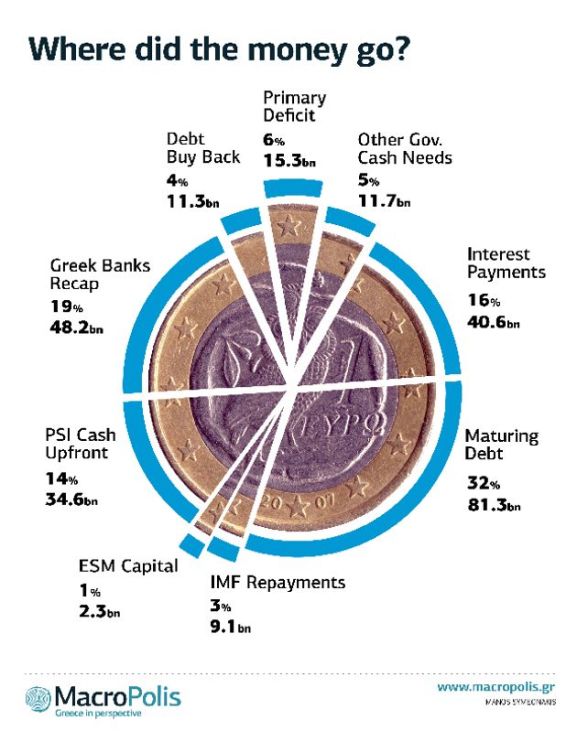
“Eurozone leaders made a conscious decision to use almost two thirds of their “taxpayers’ money” (as they like to refer to it) to service the debt which they refused even to reprofile at the beginning of the crisis, when it was essential and could have given Greece a chance of recovery”. Find out more on where the money went from Yiannis Mouzakis at the Macropolis blog
How to cut French unemployment by 700,000
France’s unemployment has hit a new high and yet economists and politicians continue to stick to the same ideas that do not work, supply-side policies such as making it cheaper to hire and fire workers and cutting corporate taxes.
But, according to Terre de Liens Normandie, a campaigning group, investing in the agriculture based on organic products and the principle of food sovereignty would create 700,000 jobs in France.
It would mean rejecting the EU’s unfair and ineffective Common Agricultural Policy, the idea that French farmers can and should compete in global markets and consumers making a conscious choice of buying from their local farmers instead of giant supermarkets that simply make large shareholders rich on their exploitative global supply chains.
But the prize is big – the organisation estimates that the minimum number of farm workers required to create a genuinely sustainable agricultural sector delivering high quality products to local communities would be 1.2 million, compared to less than 500,000 today. Sounds like a win-win.
30.12.2014
Spain axes 24,000 state school teachers in just two years
The impact of austerity policies on Spain’s education system has been highlighted by new figures showing that 24,000 school teaching posts have been axed over the past two years.
The right-wing Popular Party government has deleted 24,248 non-university public education jobs, according to data released by the Ministry of Finance.
Of these, 19,861 were in fixed, full time employment. The data also shows a growing casualisation of the workforce – the number of temporary jobs are replacing permanent posts, according to the CCOO union
Separate figures show over 8,000 posts have been cut in state universities, of which 1,800 were lecturers. A growing proportion of the university workforce are on precarious work contracts, the official data also shows.
(2/3.7.2014)
Spain sees 500% rise in ‘very long-term unemployment’
Over one million people in Spain – the eurozone’s fourth largest economy – haven’t had a job since 2010, according to a report by Spain’s National Statistics Institute. Although this number continues to rise, the government says it’s witnessing recovery.
The numbers, published on May 23, show that “very long-term unemployment” in the country has risen by more than 500 percent since 2007. That year, about 250,000 Spaniards were unemployed after losing their job at least three years prior. That number drastically rose to 1.27 million in 2013 – 234,000 more than in 2012.
Generally, long-term unemployment includes jobless workers who have not been employed for more than 27 weeks. The recent study shows that this category in Spain has transformed to very long-term unemployment, with hundreds of thousands people without a job for at least three years, and is now represented by over 23 percent of the total jobless population in Spain.
The number is much higher than in other countries in the region at the same economic level, with another recent study showing that 26 percent of the country’s population is on government benefits in Spain – the second highest total in the EU after Greece.
RT (30.5.2014)
Who voted for Marine Le Pen?
In the May 2014 European elections, one voter in four put a cross on Front National ballots.
According to an Ipsos-Steria poll, 43% of blue collar workers chose the party of Marine Le Pen (against 35% in 2012), and 38% of white collar workers.
Blue collar workers in particular continue to show their disaffection with the left, since only 22% of them voted for the ruling Socialists, the radical Left Front or Ethe greens (EELV).
However, above all it was abstention that dominated in these categories: 65% of workers abstained, against 57% of all registered voters. The Front National also scored well among the young (30% of the under 30s) and women (24%) while previously its electorate was hitherto very male.
Alternatives Economiques
The winner was…

The largest party in the European Parliamentary elections held 22-25 May elections was the abstentionist party.
Non-voters topped the polls with an average of 57% across Europe. They scored particularly stunning victories in the new states to the east Slovenia (79% non-voters) Czech Republic (81%) and Slovakia (a whopping 87%). In the UK, non-voters also wiped the board with 66%.
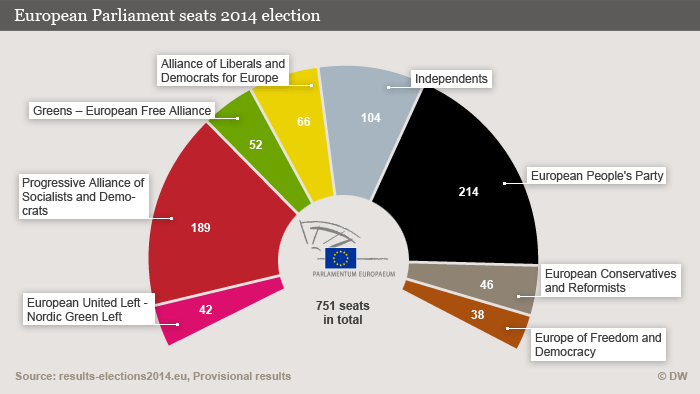
And the other parties…
Eurozone – what recovery?

Is the Eurozone economy recovering?
In the first quarter it posted slower-than-expected growth with the combined currency bloc scraping together growth of 0.2% between January and March, in line with growth in the previous quarter but disappointing expectations of 0.4% growth. There was a huge divergence in fortunes, with Germany growing at the fastest rate of all 18 countries, with gross domestic product increasing by 0.8%. It followed 0.4% growth in Europe‘s largest economy in the previous quarter. The pace of recovery also accelerated in Spain, with growth of 0.4% outpacing a 0.2% increase in GDP in the previous three months. A
At the bottom of the pile was the Netherlands, which suffered a shock 1.4% contraction in GDP, reversing 1% growth in the previous quarter. Portugal’s economy shrank by 0.7%, following growth of 0.5% in the final three months of last year. The French and Italian economies were also dealt a blow, with zero growth in France and a 0.1% contraction in Italy in the first quarter. It followed 0.2% growth and 0.1% growth in the fourth quarter of 2013
The Guardian (15.5.2014)
Check out Banks at the Trough : Filthy Rich : Shedloads for Shareholders : Wages : Wealth inequality : Gender inequality : Poverty : Tax Dodging : Catch up on latest news here
Euroscepticism is soaring amid bailouts and spending cuts

Public confidence in the European Union has fallen to historically low levels in the six biggest EU countries, raising fundamental questions about its democratic legitimacy more than three years into the union’s worst ever crisis, new data shows. Figures from Eurobarometer, the EU’s polling organisation, analysed by the European Council on Foreign Relations (ECFR), a thinktank, show a vertiginous decline in trust in the EU in countries such as Spain, Germany and Italy that are historically very pro-European. The six countries surveyed – Germany, France, Britain, Italy, Spain, and Poland – are the EU’s biggest, jointly making up more than two out of three EU citizens or around 350 million of the EU’s 500 million population.
The Guardian (24.4.2014)
Check out Banks at the Trough : Filthy Rich : Shedloads for Shareholders : Wages : Wealth inequality : Gender inequality : Poverty : Tax Dodging : Catch up on latest news here
Greek debt hits new record

Greece recorded a government debt to GDP ratio of 175.10% in 2013, an all time high, according to Eurostat. In 1980 the debt was 22.60%, a year before it joined the EU. (23.4.2014)
Check out Banks at the Trough : Filthy Rich : Shedloads for Shareholders : Wages : Wealth inequality : Gender inequality : Poverty : Tax Dodging : Catch up on latest news here
European Child Poverty on the increase
Almost 27 million minors are at risk of poverty or exclusion from society in Europe, according to data from the EU’s Quality of Life Survey for 2012, which is used in a Save the Children report on child poverty that was published this week.
The report shows that a million more children are now living in poverty compared to 2008, when the economic crisis began, although half the increase was registered between 2011 and 2012. According criteria set down by AROPE – which takes into account a household’s earnings, ability to provide food and clothing, and whether parents are employed – 20.8% of the population aged 18 or under in the EU lives below the poverty line.
In Spain, the figure is 29.9 %, the highest after Romania. Overall in the EU, nine percent of children live in homes where parents are not fully employed, and 11.8 percent lack proper food or clothes. In total, 28 percent of minors are at risk of poverty and social exclusion. Spain once again heads the ranking, with 33.8% of children affected by AROPE’s poverty criteria.
(El Pais, 16.4.2014)
Check out Banks at the Trough : Filthy Rich : Shedloads for Shareholders : Wages : Wealth inequality : Gender inequality : Poverty : Tax Dodging : Catch up on latest news here
Austerity in Greece caused more than 500 male suicides
A study has found a clear link between spending cuts and rise in number of men who killed themselves between 2009 and 2010. Echoing official statistics in the UK showing suicide rates are still higher than before the crisis, researchers at the University of Portsmouth have founda correlation between spending cuts and suicides in Greece.
According to the research, every 1% fall in government spending in Greece led to a 0.43% rise in suicides among men – after controlling for other characteristics that might lead to suicide, 551 men killed themselves “solely because of fiscal austerity” between 2009 and 2010, said the paper’s co-author Nikolaos Antonakakis.
(The Guardian, 21.4.2014)
Check out Banks at the Trough : Filthy Rich : Shedloads for Shareholders : Wages : Wealth inequality : Gender inequality : Poverty : Tax Dodging : Catch up on latest news here
Italy unemployment hits new record
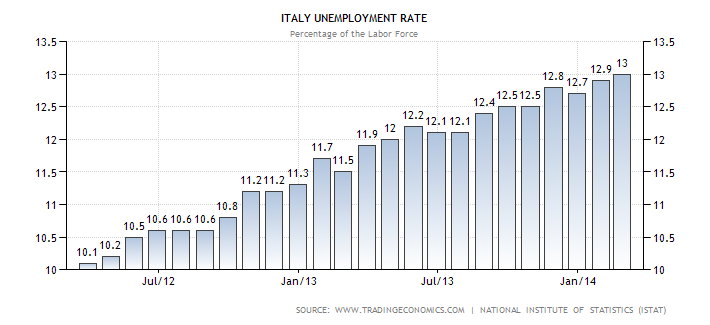
Italy’s unemployment rate hit a new record of 13% in February 2014, according to Istat. That’s the highest level since records began in 1977. Youth unemployment, measuring job-seekers between 15 and 24 years old, was 42.3% in February, down from 42.4 percent in January, still close to its highest level in 37 years. The weaknesses in Italy’s labour market are equally evident in its chronically low employment rate, which was at 55.2 percent in February, down from 55.3 percent the previous month. In February, there were 3.307 million registered unemployed, 8,000 more than the previous month, and 272,000 or 9% more than the same month last year.
Reuters, 1.4.2014
Check out Banks at the Trough : Filthy Rich : Shedloads for Shareholders : Wages : Wealth inequality : Gender inequality : Poverty : Tax Dodging : Catch up on latest news here
European Low-flation or is it a sign of Deflation?
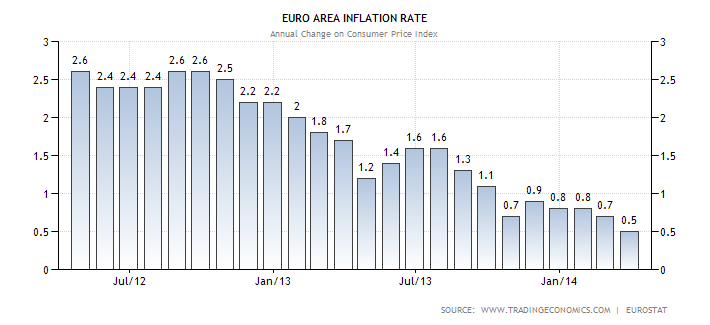
Euro zone inflation hit its lowest level since November 2009 in March. Annual consumer inflation in the 18 countries sharing the euro was 0.5 percent in March, with the pace of price rises cooling from February’s 0.7 percent reading, according to EU’s statistics office Eurostat.
The euro zone is far from the deflation that Japan suffered from the early 1990s, when falling prices weakened demand, leading to wage cuts and even lower prices, but the bloc’s low inflation rate is a clear sign of economic fragility.
Inflation has now been in the ECB’s “danger zone” of below 1 percent for six consecutive months. Speculation has grown that it may employ, in addition toborrowing rate cuts, other easing measures such as a negative deposit rate or even U.S.-style bond-buying.
Some euro zone members, like Ireland, Cyprus and Greece have experienced falling prices in recent months. For the bloc as a whole, price rises for industrial goods outside the energy sector were very modest in March, a sign demand remains weak.
Reuters 31.3.2014
Official figures mask 24% jobless rate in Europe’s South, Ireland
Actual jobless rates in Europe are two points higher than official figures suggest, hitting 15.6 million in Europe’s south and Ireland.
According to the Oficina Precaria de España and la Associaçao de Combate a Precariedade de Portugal the real rate is 24%. Official statistics agencies exclude those who are not actively seeking work or underemployed, that is involuntarily working part time when they want full time posts. In Spain, 300,000 are hidden from the jobless figures, for example.
The two organisations pledged that in 2014 they would step up the fight against the Troika, austerity and the politics in favour of the richest 1%.
El Publico 30.12.2013
Check out Banks at the Trough : Filthy Rich : Shedloads for Shareholders : Wages : Wealth inequality : Gender inequality : Poverty : Tax Dodging : Catch up on latest news here
Homeless soars in EU austerity capital Greece
The latest data presented by the Municipality of Athens and the City of Athens Homeless Shelter (KYADA) is shocking. More than 20,000 residents of the capital rely on social structures of the municipality for daily survival.
Of the total of 1,667 people who participate in soup kitchens, 66% are Greeks. In fact, 44% have a high educational level, while 7.5% has a university title and four people have a master or a doctorate. Three in four (74 %) don’t have a supportive family environment as they are unmarried, divorced or separated. Seventy seven percent are unemployed and 76% of them declare zero in income. Soup kitchen provides food to 85% at least once a day, but for many, two times per day.
Regarding the homeless, half of them (49%) resort to begging and about 54% do not want support to find shelter. Moreover, of the 774 families who request to be admitted to the program social grocery, 587 are Greek.
Greek Reporter 4.11.2013
EU unemployment hits new record of 12.2%
The unemployment rate across the 17-country eurozone hit a record 12.2 per cent in September, with about 19.5 million people classed as jobless by the EU data agency Eurostat.
The figures showed that the unemployment rate for August had been revised up from 12.0 per cent to 12.2 per cent.
But with an extra 60,000 people registered as unemployed across the single currency area that meant nearly 19.5 million people were listed as out of work.
The seasonally-adjusted figures compare unfavourably with the rate for the United States, given as 7.2 per cent for the same month.
Chronic youth unemployment data showed some 3.5 million people under the age of 25 listed as jobless.
The top German economy had the lowest rate in this category, of 7.7 per cent.
Greece and Spain each recorded around 57 per cent – with non-euro but new European Union entrant Croatia also suffering from similar youth unemployment.
Ekathimerini / AFP 31.20.2013
Spain: austerity, labour reforms destroy 400,000 permanent jobs
Some 400,000 jobs have been lost in Spain since deregulatory labour reforms were imposed last year by the right wing Popular Party government of Mariano Rajoy.
Rajoy and his party have been increasingly upbeat over recent jobless figures with Vicente Martínez-Pujalte, economic spokesman, hailing the unemployment data for the three months to September as an ‘inflection point’, showing that ‘there is a change in the tendency in Spain and that we are on a good path’.
In the third quarter of 2013, unemployment fell by 72,800. However, compared to a year ago there are 126,770 more unemployed.
Furthermore, the number of salaried employees in work increased by 23,200 in the last quarter, but the growth was driven by a rise in temporary contracts (up 169,500 ) while the number of employees on permanent contracts fell (by 146,300 or 406,200 at an annualised rate) .
A Spanish collective, Economists Against the Crisis, says: ‘The negative effects of labour reform in 2012 continue to be felt, contributing to a growing casualization of wage employment, in addition to an intensification of long-term unemployment, in the absence of active employment policies.’
Jobs in industry, meanwhile, are disappearing at a rate of 7% a year.
Marcel Jansen, a professor of economics at Madrid’s Autónoma university, said: ‘The jobs that are being destroyed are permanent jobs in areas like manufacturing and the ones that are being created are temporary jobs in areas like tourism. These are not stable jobs and it is possible that many of them will disappear in the fourth quarter.’
Spain’s unemployment rate, at 26%, is the second highest in Europe, only beaten by Greece. The latest labour market survey came just days after the Bank of Spain announced that in the third quarter growth returned to the economy, after nine consecutive quarters of falling output. However, as with the latest jobs data, the rise in output was minuscule, at just 0.1 per cent.
Nueva Tribuna ; Financial Times 24.10.2013
Check out Banks at the Trough : Filthy Rich : Shedloads for Shareholders : Wages : Wealth inequality : Gender inequality : Poverty : Tax Dodging : Catch up on latest news here
Greece: bank deposits fall in Sept. for 4th month
Greek bank deposits dropped for the fourth straight month in September, central bank data showed on Friday, as austerity-hit households run down bank accounts to pay higher taxes imposed under Greece’s international bailout.
Deposits of businesses and households fell 0.5 percent from the previous month to 161.35 billion euros (137.57 billion pounds), the Bank of Greece data showed, bringing total net outflows since June to 1.79 billion euros.
As deposits shrink, tight credit amid the country’s deepest postwar slump is sapping demand for loans.
Credit to the private sector shrank 3.9 percent year-on-year, the pace of contraction unchanged from August, the central bank said. Loans to the private sector have been contracting continuously for more than two years, aggravating Greece’s economic crisis.
Despite record low interest rates from the European Central Bank, Greek businesses’ inflation-adjusted borrowing costs have hit an average 6.6 percent, their highest level since the country joined the euro area, government estimates show.
Ekathimerini 25.10.2013
Check out Banks at the Trough : Filthy Rich : Shedloads for Shareholders : Wages : Wealth inequality : Gender inequality : Poverty : Tax Dodging : Catch up on latest news here
One in six Germans in poverty, and rising
Despite the strong economy, the number of impoverished Germans has been steadily increasing. Figures from a European-wide study released on Friday show one in six people are at risk of poverty.
That is considerably more than in Germany’s neighbouring countries, the Czech Republic and France.
The figures from the German Office of National Statistics (Destatis) and Eurostat, which included 13,145 German households, showed 16.1 percent of Germans were at risk of falling into relative poverty, compared to 9.6 percent in the Czech Republic, 10.1 percent in the Netherlands and 14.1 percent in France.
It also suggested that relative poverty in Germany has been rising in spite of the robust economy and falling unemployment. Back in 2005, the number of people at risk of poverty was 12.2 percent. That figure had risen to 16.1 percent in 2011.
The Local 25.10.2013
Check out Banks at the Trough : Filthy Rich : Shedloads for Shareholders : Wages : Wealth inequality : Gender inequality : Poverty : Tax Dodging : Catch up on latest news here
Italy: banks’ bad loan ratio rises to record 9.5%, up 250% since start of crisis
Italian banks’ bad loans as a percentage of total credit rose to a new high of 9.5% this year, up 251% from the start of the country’s longest recession in over two decades, according to leading Italian merchant bank Mediobanca. The overall bad loan ratio was 2.7% in 2007. The bad debt ratio has been increasing at a faster rate in recent months, Mediobanca’s centre of studies also noted.
Mediobanca’s data showed that the share of bad debt in Italian banks’ net capital reached 81% while performing loans are decreasing.
Ansa 24.10.2013
Check out Banks at the Trough : Filthy Rich : Shedloads for Shareholders : Wages : Wealth inequality : Gender inequality : Poverty : Tax Dodging : Catch up on latest news here
Greeks 40% poorer than in 2008
Greeks are on average almost 40% poorer than they were in 2008, data has indicated, laying bare the impact of a brutal recession and austerity measures the Government may be forced to extend into next year.
Gross disposable incomes fell 29.5% between the second quarters of 2008 and 2013, Greek statistics service ELSTAT has revealed.
Adding in cumulative consumer price inflation over the same period takes the decline close to 40 per cent.
Spending cuts and tax hikes to meet the terms of international loans, coupled with record unemployment have eroded domestic consumption, which in Greece accounts for about three-quarters of gross domestic product.
Total workers’ compensation has fallen 34% since the second quarter of 2009, the ELSTAT data showed. Over the same period, the government slashed social benefits by 26pc.
Independent.ie 23.10.2013
Check out Banks at the Trough : Filthy Rich : Shedloads for Shareholders : Wages : Wealth inequality : Gender inequality : Poverty : Tax Dodging : Catch up on latest news here
Italy’s debt hits record high of 133.3% in 2nd quarter
Italy’s public debt hit a record high of 133.3% of gross domestic product in the second quarter of 2013, compared to 130.3% in the first three months of the year, according to Eurostat.
The EU’s statistics office said Italy’s debt was the second-highest in the union with respect to GDP after Greece’s, which stood at 169.1%.
ANSA 23.10.2013
Check out Banks at the Trough : Filthy Rich : Shedloads for Shareholders : Wages : Wealth inequality : Gender inequality : Poverty : Tax Dodging : Catch up on latest news here
67 billion subsides to Euro banks in 2011-12 and that’s tip of iceberg
New figures show the continuing generosity of government to banks even mile its austerity for everybody else. Eurostat, the EU statistical service, has released a survey of government deficit and debt data for 2011 – 2012.
A special part of this Eurostat survey is devoted to the estimates of subsidies accorded to banks. According to those estimates, during the two-year period of 2011- 2012, the impact of the support to financial institutions on government deficits was 0.7% of Eurozone’s GDP, or €67 billion.
However, this is likely to be the tip of the iceberg. Government (aka taxpayer and all citizens) support to failing banks in Eurozone reached €4.5 trillion during the first years of the crisis.
European Sting 22.10.2013
Check out Banks at the Trough : Filthy Rich : Shedloads for Shareholders : Wages : Wealth inequality : Gender inequality : Poverty : Tax Dodging : Catch up on latest news here
Three million Spaniards now live in dire poverty, says Cáritas
After five years of crisis, more than three million Spaniards are now living in dire poverty, as defined by monthly income of under 307 euros, according to a report by charity organization Cáritas.
Cáritas’ Living Conditions Survey, which is included in the organization’s Social Reality Observatory for 2012, shows that the percentage of the population now living below the breadline has almost doubled from 3.5 percent in 2007 to 6.4 percent last year.
The Catholic charity speaks of a “second wave of poverty and social exclusion,” exacerbated by the government’s austerity drive and spending cuts, accompanied by continued high and prolonged unemployment with increasing numbers of jobless no longer entitled to state benefits.”
The report also highlights growing inequality in the country to the highest levels in Europe. It points to figures from the European Union’s statistics office Eurostat that show that the richest 20 percent of the population in Spain have 7.5 times more wealth than the poorest 20 percent. “We are approaching a model of social Darwinism, with few winners and lots of losers,” the report says.
Cáritas’ report was released a day after Swiss investment bank Credit Suisse published its latest Global Wealth Report, which showed that the number of millionaires in Spain rose by 13 percent to 402,000 between mid-2012 and the middle of this year, despite the country’s longest recession in half a century.
El Pais 10.10.2013
Check out Banks at the Trough : Filthy Rich : Shedloads for Shareholders : Wages : Wealth inequality : Gender inequality : Poverty : Tax Dodging : Catch up on latest news here
Greece: Youth Unemployment jumps to 55%
Greece’s youth unemployment rate jumped to 55.1% in July as the country continues to suffer from the austerity driven economic crisis.
According to the Greek Statistical Authority Elstat, the youth unemployment rate soared in July 2013, up from 54.9% in July 2012 and an increase from 42.6% in July 2011.
International Business Times 10.10.2013
Italy: households’ spending power crumbles
The spending power of households in recession-hit Italy dropped 1.7% in the first half of 2013 compared with the same period last year.
According to the national statistics agency families’ spending power fell 0.7% in the April-June period compared to the first three months of this year and 1.3% with respect to the second period in 2012.
ANSA 8.10.2013
Check out Banks at the Trough : Filthy Rich : Shedloads for Shareholders : Wages : Wealth inequality : Gender inequality : Poverty : Tax Dodging : Catch up on latest news here
Germany: richest are richer than ever
Germany’s super-rich are wealthier than ever, led by the founders of discount supermarket chains, according to a ranking by the country’s Manager magazine.
The magazine’s annual top 500 rich list, which contains 135 billionaires, stated: “Never before were Germany’s super-rich richer than today, never before have there been so many billionaires.”
The combined wealth of Germany’s top 100 billionaires rose by 5.2 percent in the past 12 months to €336.6 billion – topping the previous record of €324.6 billion in 2008, as the world economic crisis started to hit.
The Local 7.10.2013
Check out Banks at the Trough : Filthy Rich : Shedloads for Shareholders : Wages : Wealth inequality : Gender inequality : Poverty : Tax Dodging : Catch up on latest news here
Italian spending power plunges to lowest level since 1990
The spending power of households’s in recession-hit Italy dropped 4.7% last year, taking it down to its lowest level since Istat starting using its current calculation method in 1990, according to the national statistics agency.
Istat said disposable incomes dropped 2% in 2012 and Italians’ propensity to save money fell to the lowest level in 22 years..
Ansa 3.10.2013
Italy: Youth unemployment reaches record of 40.1%
Youth unemployment in recession-hit Italy crossed the 40% mark for the first time in August, when 40.1% of 15-to-24-year-olds on the job market were out of work, national statistics agency Istat said.
According to provisional data, the youth unemployment rate was 0.4% higher in August than in July and 5.5% up on the same month in 2012. The rate had never been over 40% since Istat started using its current calculation method in January 2004 for monthly data and in the first quarter of 1997 for quarterly data.
The agency said 667,000 under-25s were without a job and actively looking for work, according to preliminary data not adjusted for seasonal variations.
Young people who are in eduction and training are not considered part of the job market and neither are those who have given up hope of finding a job and not actively looking for one.
Istat said the young people who are unemployed and actively looking for work amounted to 11.1% of all people in the 15-24 age range.
Ansa 1.10.10
Spain: Wage freeze for 2.8 million public workers extended into next year
The Finance Ministry has confirmed to labour union representatives that public sector wages will again be frozen next year as part of the government’s state budget proposals.
Speaking in the Senate, Prime Minister Mariano Rajoy made a strong hint that Spain’s 2.8 million public workers will see their salaries remain at a standstill for the fourth year in a row. The Socialist government of Prime Minister José Luis Rodríguez Zapatero cut their wages by five percent in 2010.
The public sector workforce was also deprived of its Christmas bonus last year, but Rajoy said the economy had improved sufficiently for that not to be the case again.
The freeze in wages next year will also be applied to regional governments.
Labor unions estimate that public sector workers have lost 20 percent of their purchasing power as part of the government’s austerity drive, which is aimed at reining in the public deficit.
El Pais 26.9.2013
Italy: Increased antidepressant use ‘a sign of economic crisis’
The increase in the use of antidepressants indicates the longer-term toll on Italians from years of social and economic crisis, a senior psychiatric specialist said.
Almost one-third of the adult population is dealing with some kind of emotional or mental issue, said Claudio Mencacci, president of the Italian Society of Psychiatry (SIP).
He spoke after a report showed a steady rise in the amount of antidepressants being used by Italians.
“These figures do not surprise us at all,” he said.
“For this reason, the SIP urges institutions and the public to become aware of the spread of mental disorders, and depression,” he added.
He warned the medical system may eventually become “overwhelmed by these pathologies,” if better and more rapid treatment for disorders is not found.
Ansa 24.9.2013
Spain: 873,000 had free healthcare axed, mostly immigrants
Hospital budget cuts and new charges for medicine are blocking healthcare access to hundreds of thousands of people in Spain, including the seriously ill, a top health charity warned Tuesday.
Despite the government’s recent claims that the economic crisis is easing, Medicos del Mundo said last year’s spending cuts were hitting the most vulnerable people and raising health risks.
“The impact we have seen in the year since the reform is simply devastating,” the president of the organisation, Alvaro Gonzalez, told a news conference, launching a new publicity campaign against the cuts.
Citing government figures, he said 873,000 people had had their access to Spain’s free public healthcare system discontinued since September 2012 — most of them immigrants whose entitlement lapsed because they lost their jobs.
“The government is insisting that the economy is recovering… but still our health system, which in past years was the envy of neighbouring countries, is suffering one cut after another,” Gonzalez said.
Some of the regional authorities that control local health budgets have also started making patients pay part of the cost of their prescriptions.
“This has meant that 16 percent of the pensioners in our country are being cast out of the healthcare system because they cannot meet the cost of paying for medicine for their chronic illnesses,” Gonzalez said.
The government has also ended public healthcare for immigrants from some countries who do not have residency permits.
“The cuts to healthcare are especially harming those most affected by the recession: immigrants, people looking after those with special needs, families on low incomes and pensioners,” Gonzalez said.
France24 24.10.2013
Check out Banks at the Trough : Filthy Rich : Shedloads for Shareholders : Wages : Wealth inequality : Gender inequality : Poverty : Tax Dodging : Catch up on latest news here
Portugal: Number of jobless couples up 45 percent in a year
More than 12,000 Portuguese couples were both out of work in June 2013, a 45 percent increase over the past 12 months, the Portuguese Employment and Professional Training Institute (IEFP) said.
According to the figures released by the IEFP the additional 3,749 couples was equivalent to another 45.1 percent over and above the figures in June 2012.
There was, however, a slight 3.3 percent drop when compared with May, when there were almost 12,500 jobless couples. At the end of June there were 653,967 job seekers registered with employment centres in mainland Portugal.
TPN/ LUSA 22.8.2013
Check out Banks at the Trough : Filthy Rich : Shedloads for Shareholders : Wages : Wealth inequality : Gender inequality : Poverty : Tax Dodging : Catch up on latest news here
Portugal: Union hails drop in construction accidents, warns against safety cuts
Portugal’s main construction union has said that the number of deaths in work accidents in the industry in the first half of 2013 was down more than a third on a year earlier, but warned of a possible reversal of the trend due to cuts in spending on safety.
The union’s president, Albano Ribeiro, visited the recently completed viaduct over the Corgo, near Vila Real, to highlight its exemplary status, with €3 million being spent on safety-related measures. Despite being 2,796 metres long and 197 metres high no fatal accident took place during its construction, he stressed.
From January to June, 17 people died in construction sector accidents, down from 25 a year earlier. That compares with as many as 196 in the whole of the peak year of 1997. Ribeiro noted that the union had in the period carried out 210 initiatives to promote safety in the sector.
But he warned that the number of accidents could rise again due to the crisis, which he said “contributes to the reduction of investment on the part of many companies in safety.”
He noted a tendency for thousands of small construction works being carried out by companies that put profit before safety, and said that inspectors often lack the means, including vehicles, to do their job.
TPN/ LUSA, ·8 August 2013
Check out Banks at the Trough : Filthy Rich : Shedloads for Shareholders : Wages : Wealth inequality : Gender inequality : Poverty : Tax Dodging : Catch up on latest news here
Poorest French cut food spend as austerity bites
While the wealthiest French families increased their wealth by 25% in 2012, those on ‘modest’ incomes are cutting back on food spend, raising questions about declining nutritional standards. According to INSEE 20% of the poorest families consume 38% less than the average and half the population is being forced to make savings on food.
27 July, L’Humanite
Check out Banks at the Trough : Filthy Rich : Shedloads for Shareholders : Wages : Wealth inequality : Gender inequality : Poverty : Tax Dodging : Catch up on latest news here
Italian poverty soars
The number of people living in absolute and relative poverty in Italy jumped in 2012 with families in southern regions hit especially hard, highlighting the human cost of the country’s longest post-war recession.
About 4.8 million people, or 8 percent of the population, now face absolute poverty, meaning they are unable to afford the minimum acceptable standard of living, the report from statistics office ISTAT showed. That figure has jumped from about 3.4 million in 2011.
An additional 9.56 million people, or 15.8 percent of the population, are relatively poor for Italian standards, the data showed, up from 8.17 million people in 2011.
Levels are especially high in the traditionally poorer south of the country, where almost one in three people face relative poverty, while 11 percent are suffering absolute poverty.
Poverty levels rose particularly among families with several children, while single people were less affected, ISTAT said. Rates were also higher among families whose main breadwinner is unemployed or a factory worker, or who include two or more elderly people.
Reuters July 17, 2013
Check out Banks at the Trough : Filthy Rich : Shedloads for Shareholders : Wages : Wealth inequality : Gender inequality : Poverty : Tax Dodging : Catch up on latest news here
80,000 Italians go abroad to have sex with minors
About 80,000 Italians travel each year to the Dominican Republic, Colombia and Brazil, Eastern Europe and South East Asia to have sex with minors, according to ECPAT Italy, an international network that fights against the sexual exploitation of children. In Kenya 15,000 girls living in Malindi, Bombasa, Kalifi and Diani – typically 12- 14 years old, but some 9, 7 or 5 years old – are bought by Italians.
According to ECPAT Italy, they are not necessarily all pedophiles with many exhibiting normal sexual behaviour at home.
According to a study conducted by the University of Parma and coordinated by ECPAT, the age of sexual tourist has dropped and no longer corresponds exclusively to the old cliché of classic pedophile: People who are looking for sex with minors abroad are between 20 and 40 years old, may be married or single, male or female (although the majority are boys), rich or budget travellers. They may have a high socio-economic level or come from a disadvantaged background.
Controlacrisi 9.6.2013
Check out Banks at the Trough : Filthy Rich : Shedloads for Shareholders : Wages : Wealth inequality : Gender inequality : Poverty : Tax Dodging : Catch up on latest news here
One in three Greek children living in poverty
There are over half a million poor or socially marginalised children in Greece, while 322,000 of these are in dire straits materially, according to a report by “The state of the children of Greece 2013” conducted by the United Nations International Children’s Emergency Fund (UNICEF), in collaboration with the University of Athens, presented Wednesday in downtwown Athens.
“The situation is very troubling,” said UNICEF’s Greek branch director Lambros Kanellopoulos to ANA-MPA, and called on the government to heed the organisation’s proposals to deal with them.
The organisation is holding a radio marathon on May 28 to raise money for children through appeals on radio. According to Professor Dimosthenis Daskalakis, the survey is based on 2011 data. Highlights of the findings include the following:
* The number of children facing poverty or social marginalisation is 597,000 or 30.4 pct of the children in the general population, a 9.1 pct increase over 2010.
* Children facing “multiple disadvantages” in homes of abject poverty and low employment reached 69,000 in 2011 (over 12,000 in 2010).
* A little over 9 pct of children live in households with no adult working (2011), a 2.9 pct rise over 2010.
* 322,000 children, or 16.4 pct of all under-age children, live in households that are seriously materially deprived; this is a 38.2 pct increase from 2010 to 2011, or 89,000 children. Age-wise, the 6- to 11-year-olds in this group comprise 46.7 pct.
The report also included data on immigrant children and safety issues. It said, for example, that children in Greece are exposed to accidents at a much higher rate than in other countries of the eurozone; for children 15-19 years old, the fatality index from transportation accidents is 17.8 pct, compared to 9.2 pct, the EU average
Athens Macedonia News Agency 22.5.2013
Check out Banks at the Trough : Filthy Rich : Shedloads for Shareholders : Wages : Wealth inequality : Gender inequality : Poverty : Tax Dodging : Catch up on latest news here
Greece: 25% increase in homeless
Greece has seen a 25% increase in homeless, while more than one out of three Greeks (38%) had already fallen below the poverty line in 2012, and the poverty rate for under-17s was close to 44%, according to UN expert on debt and human rights, Cephas Lumina.
Ekathimerini 5.5.2013
Spain: Poverty levels rise 8% since start of crisis
Poverty levels in Spain increased by 8% between 2006 and 2011, according to the report on Human Development and Poverty in Spain by the Valencian Institute of Economic Research (IVIE) and Fundación Bancaja .The study found that human development, an aggregrate index that looks at improvements in education, health and material wellbeing, increased 4.4% less than if there had not been the austerity-driven economic crisis in the country. Material wellbeing fell 13.7%, while the education and health elements of the index held up, but were at risk if the economic crisis continued, as evidence from Greece and Russia has shown, the study warned. Sharp cuts in public spending and tax rises designed to meet EU deficit reduction goals have sent Spain into a deepening ‘double-dip’ recession, with unemployment now standing at more than 6 million. Wages have been cut and homelessness is rising, thanks to eviction orders by banks in receipt of billions of EU funds. Separate figures released recently by Caritas, the Roman Catholic relief organisation, found some 3 million Spaniards were living in extreme poverty.

Poverty Index
Press release
Full report
Check out Banks at the Trough : Filthy Rich : Shedloads for Shareholders : Wages : Wealth inequality : Gender inequality : Poverty : Tax Dodging
France: Poverty increases as top 1% gets richer
Three studies by the official statistics agency INSEE published Wednesday shows that, as a result of the crisis, the living standards of the majority of the population is stagnant or declining, while the rich get richer.
The figures show the number of people living in households whose standard of living is below the poverty line (964 euros / month) increased from 13.5% in 2009 to 14.1% of the population in 2010, the latest year for which figrues are available. That’s 440,000 more poor people in one year.
The increase in poverty disproportionately affected pensioners, students, the unemployed, and “particularly affects families,” says INSEE, which found that 2.7 million children grew up in poor families, an increase of 278,000.
The poorest 10% had to get by on less than 10,430 euros per year when the 10% richest accumulate at least 36,270 euros per year. A ratio of 1 to 3.5.
The richest 1% became richer thanks to inherited wealth, which explains in part the increase of nearly 5% in their standard of living in 2010.
Nevertheless, the French social protection system, including family benefits, housing benefits and welfare benefits helped cushion the impoverishment of the masses.
Humanite INSEE
Portugal: Debt tops €200billion
The country’s public debt stood at €204.5bn at the end of 2012, surpassing the €200bn mark for the first time. The numbers released by the National Statistics Institute (INE) also confirm the economy contracted 6.4%.
Portugal’s public debt reached 123.6% of Gross Domestic Product (GDP) in 2012, a €20bn jump in just one year and higher than the estimate given by the government and troika less than two weeks ago.
Figures released by the National Statistics Institute (INE) also confirmed the economy contracted 6.4%, higher than the 5% target agreed with the so-called troika of international lenders (European Commission, European Central Bank and International Monetary Fund).
INE said the public debt rose 15.3 percentage points of GDP in comparison with 2011, though the GDP also fell considerably, adding to the difference.
At the end of 2012 the public debt stood at €204.5bn, and it was the first time ever it has been over the €200bn mark.
The economic recession, the worst since 1975, reduced the country’s GDP by some €5.6bn from €171bn in 2011 to €165.4bn.
Portugal Daily View 28.3.2013
Italy: Booming poverty: over 4 million in 2013
Italians work more than the Germans
A study by Confcommercio has found that every day 615 Italians join the ranks of the poor with the number in abolute poverty to total as many as 4.2 million by the end of 2013. The data is part of a misery index produced by the research unit of the Italy business association. That’s than a rate exceeding 6%, compared to 3.9% in 2006.
The study also found that despite the rise in misery, Italians work harder than the Germans, dbeunking a myth about their supposed ‘laziness’. In 2011 Italians worked 1,774 hours each, that’s 20% more than the French and 26% more than the Germans.
La Repubblica 22.3.2013
Check out Banks at the Trough : Filthy Rich : Shedloads for Shareholders : Wages : Wealth inequality : Gender inequality : Poverty : Tax Dodging
Spain: Gap between rich and poor widening
The income gap between the richest and poorest people in Spain has widened by 30 percent since 2006 due to the country’s sharp economic downturn, according to the Spanish branch of Catholic charity Caritas.
Falling salaries, government cuts to social benefits and high unemployment — currently at a record 26 percent — are behind the “unprecedented rise in income inequality” which is among the highest in the European Union, the charity said in a new report.
“The strong growth of social inequality reveals a fractured society. Over time it will become harder and harder for poor people to escape social exclusion,” Caritas secretary general Sebastian Mora said during a presentation of the report.
“The erosion of social policies has had an impact on the most vulnerable groups,” he added.
The average income for the richest 20 percent in Spain is seven times higher than the average income for the poorest 20 percent, according to the Caritas report.
The number of households without any source of income has jumped from 300,000 in 2007 to 630,000 in 2012, while the percentage of people who are not able to pay for an unexpected expense has risen during the same period from 30 percent to 44.5 percent, the report said.
Expatica Spain 20.3.2013
Portugal: 50,000 public sector jobs axed in past 2 years
Portugal’s secretary of state for public administration says the state reform is a “continuous, permanent process.”
Portugal’s secretary of state for public administration, Helder Rosalino, said Tuesday that 50,000 public service workers had left in the past two years.
Speaking at a parliamentary conference on the country’s bailout programme, Rosalino said: “State reform is a continuous, permanent process,” the government has been implementing.
The secretary of state said there was “no record of any restructuring of this size, at a time when demand for public services is on the rise, due to the situation in the country.”
Rosalino said that about 200,000 public sector workers performed unskilled work or about 40% of the total.
At a time of cost-cutting, companies reorganise around some jobs rather than others. In the public sector, this also has to be done,” he said.
Portugal News 20.3.2013
Italy: 1,000 companies going bankrupt every day as country faces full-scale ‘credit emergency’
Italy’s industry chiefs have warned that the country faces a “full credit emergency” as thousands of companies run out of critical funding, threatening a slide into deeper depression.
Confindustria, the business federation, said that 29% of Italian firms cannot meet “operational expenses” and are starved of liquidity. It said that a “third phase of the credit crunch” is under way that matches the shocks in 2008-09 and again in 2011.
The Italian economy is being suffocated. The country must intervene rapidly to reinject funds into the economy
It said the economy was caught in a “vicious circle” where banks are too frightened to lend, driving more companies over the edge – with 1,000 going bankrupt every day.
National Post Wire Services 17.3.2013
Spain: teacher numbers slashed as students increase
State schools cut 14% of teachers in Madrid region over the past four years while student numbers rose 17%.
The reduction amounts to the axing of around 7,000 teachers jobs, according to the UGT trade union that produced the figures.
‘The education policy of the Madrid Popular Party administration has been designed to dismantle public education,’ said the UGT.
El Publico 12.3.2013
Portugal loses 200,000 jobs in 2012
The Portuguese economy lost over 205,000 jobs last year pushing employment numbers to the lowest level in the past 17 years, according to figures released by the Portuguese National Statistics Institute (INE).
At the end of 2012, the total number of people in jobs stood at about 4,655,600, more than 200,000 fewer than at the end of 2011.
The number has been falling since 2006, though rose slightly in 2008 to fall more steeply the next year and almost half a million jobs have gone since then.
The number of job-holders is now at its lowest rate in 17 years; in 1995 the figure stood at 4,553,700.
Portugal Daily View 11.3.2013
Italy: Majority of families’ economic situation worsened in 2012
In 2012, 55.8% of households found themselves in a more difficult situation compared to 2011, an increase of 12.1 points in just one year, according to a survey by Istat, the official statistics agency. The situation in 2012 was “a little worse” for 40.8% of respondents, and had sharply deteriorated for another 15% .
The proportion of families who said their economic resources were “poor” or “inadequate” rose to 47.1%, up 4.4 points compared to 2011.
Confirming a raft of other data, those suffering the most were in the poorer South.
Two thirds of families believe their income to be below what they need, according to separate figures from the Bank of Italy. These figures however relate to 2010, decidedly more prosperous times. Those suffering most hardship are young people and those living in rented accommodation.
10.03.2013 Controlacrisi.org
Spain: crisis destroys 63,500 small businesses led by women
The number of self-employed women has fallen by 63,500 from May 2008 to December 2012.
Women represent 32.6% of all ‘autonomous’ workers in Spain, a higher number than the 31.1% EU average, exceeding those of Italy (28.7%), Greece (29.9%), France (30.5%), Belgium (31.1%) and Germany (32.2%).
Proportionally, self-employed women outweigh men in trade; catering; in professional, scientific and technical businesses, in health, administrative, insurance and finance companies, the arts, and real estate activities.
The number of male self-employed fell by 14%, compared to 6% for women, indicating women have been more resilient than men during the recession, according to the self-employed association ATA that produced the figures.
Nueva Tribuna 7.3.2013
Eurozone Economy Double Dips
The euro zone economy is back in recession. It contracted for the fourth consecutive time. Eurostat data confirmed initial estimates that GDP declined 0.6% in the three months to December, following a 0.1% drop previously. All GDP components declined. Investment dropped 1.1%, both exports and imports 0.9%, consumption 0.4%, and government spending 0.1%.The rest of the countries posted PMI’s lower than 50. Below are the quarterly growth figures.
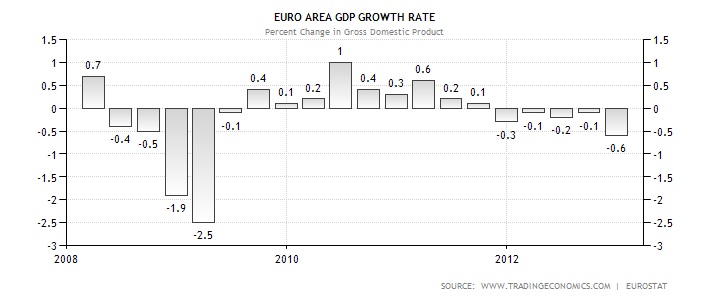
The February euro zone manufacturing purchasing managers’ index (PMI) is 47.9, pointing to additional contraction in the current quarter. The highest manufacturing PMI is 51.5 recorded for Ireland, followed by Germany whose PMI is 50..
Trading Economics
6.3.2013
Portugal: Half a million children at risk of poverty
More than half a million Portuguese children are at risk of poverty, according to data from Caritas relating to 2011, and it will continue to increase according to the head of Caritas Europe.
The child poverty rate in Portugal reached 22.4% in 2010, above the European Union average of 20.5% rising to 28.6% in 2011, again above the EU25 of 27%. The figures emerge from a report by Caritas Europa that analyzed the impact of the economic crisis and of policy measures to tackle it, particularly in the five most severely affected countries: Greece, Ireland, Italy, Portugal and Spain.
This means there are 577,865 children at risk of poverty, or social exclusion.
An individual is at ‘poverty risk’ if they live in households where the ‘equivalised‘ income is below the threshold of 60% of the national (equivalised) median income, according to Eurostat.
Diario Noticias (DN) 6.3.2013
Spain, Italy, Greece top EU youth unemployment league
Unemployment among Spaniards under age 25 hit 55.5% in January 2013, compared with the euro-zone average of 24.2% and the 50.2% seen in the same period in 2012, according to Eurostat. Greece’s youth unemployment, meanwhile, hit a record high at 59.4%, although these figures relate to November 2012. After Greece and Spain was Italy, with 38.7% of Italians under age 25 jobless, followed closely by Portugal with 38.6%.
ANSAmed 1.3.2013.
Eurozone unemployment hits new high
Further 200,000 out of work
Unemployment in the eurozone rose to an all-time high in January, with an estimated 19 million people in the bloc out of work, the EU’s statistics office said. January’s unemployment rate rose to 11.9 percent in the 17 countries sharing the euro, up from 11.8 percent in December, with another 201,000 people out of work, Eurostat said on Friday.
Overall joblessness masks a large divide, with only five percent unemployment in Austria compared with 27% in Greece. The figures were 26.2% in Spain and 17.6% in Portugal
Analysts expected unemployment to continue to rise throughout the year, even in the event of a turnaround in growth.
AL Jazeera BBC 1.2.2013
Check out Banks at the Trough : Filthy Rich : Shedloads for Shareholders : Wages : Wealth inequality : Gender inequality : Poverty : Tax Dodging
Greece: Jobseekers rise to just over 1m
Number of Greeks registered as unemployed rose 4pct to 1.02mln in January
The number of Greeks registered with Greece’s unemployment bureau as being in search of work rose slightly in January to just over 1 million.
The OAED Manpower Organization said that a total of 1,025,954 Greeks were registered with the agency in January, a 4.04 percent rise on the previous month.
A total of 64 percent of those looking for work were in the 30-54 age group.
OAED said there were 53,515 job announcements in January, which was 8.12 percent up on December but 22.02.
OAED said 27,469 firings were registered in January, which was 21 percent up on the previous month but 3.84 percent down on January 2012.
ekathimerini 18.2.2013
Greece: nearly third of population in poverty
A study by Greece’s largest labor union, GSEE projects that 3.9 million out of Greece’s total population of nearly 11 million will be officially living in poverty by the end of the year, compared with 3.1 million in 2011. The poverty line in Greece is set at a personal income of less than €7,200 ($9,700) per year.
There are 470,000 households without anyone working, according to GSEE
The union’s research suggests the jobless rate would hit 30 percent later this year.
‘When austerity measures started, unemployment was at 9 percent. Since then, incomes have been crushed and the official unemployment rate has reached 27 percent … So the notion that lower salaries will boost employment has proved to be totally false,” said Ioannis Kouzis, associate professor at Panteion University’s social policy department and adviser to GSEE.
AP 14.2.2013
Spain: Nearly 400,000 emigrate
Nearly 400,000 Spanish have emigrated to other countries to work since the beginning of the crisis
A total of 390,206 have left Spain to work or accompanying a family member who has migrated for work between early 2008 and late 2012, according to a report by employment agency Adecco, using data collected Spanish Electoral Census of Residents Abroad (CERA), issued by the INE.
In 2012 alone, more than 82,000 workers packed up and migrated to other countries in search of a job, representing an increase of 5.5% compared to 2011. In total, the number of Spanish adults who reside abroad amounts to 1.6 million people.
Since the crisis began, the number of job seekers working outside Spain has doubled, with the trend accelerating during the past two years. One in four applicants who visit the offices of Adecco sought a job abroad.
Nueva Tribuna 17.2.2013
Italy: Almost 2 million children at risk of poverty
“There are nearly two million children living in poor households and 800,000 of these are in poor families.” The numbers are appalling said the National Ombudsman for children Vincenzo Spadafora, speaking at a conference in Florence. “According to a report by Save the Children – he added – in Italy there are 500,000 ‘disconnected’ adolescents, who do not have access to the internet, to the world of culture.’
Controlacrisi 15.2.2013
Spain: Joblessness hits new high of 26%
The Spanish jobless rate increased to a record 26.02% in the fourth quarter of 2012 from 25.02 percent in the third quarter of 2012.
From 1987 until 2012, Spain’s unemployment rate averaged 16.67%, with a record low of 7.95% recorded in June of 2007, just before the global crisis hit, the bank-fuelled housing, debt bubble burst and the austerity fest commenced across Europe.
The number of unemployed persons in Spain increased by 187 300 with 363,300 net jobs destroyed in the fourth quarter of 2012. Unemployment increased by 71 100 men and 116 200 women.
Below are the quarterly jobless figures

Trading Economics 24.1.2013
Italy: Crisis hits most vulnerable hardest
The economic crisis doesn’t affect everyone to the same degree but hits the weakest hardest, according to Italian consumer association Altroconsumo. Incomes among lower income groups are falling, with the poorer South seeing incomes fall by nearly eight percent.
A growing number of families – 28% – are at risk of falling into poverty. Families in circumstances of ‘severe economic deprivation’ almost doubled between 2010 and 2011, exceeding 11%.
Analysing official data, the association finds that household income has fallen by 10% since the onset of the crisis [in 2008] and estimates that the difference between the gap between the wealthy and those with more modest means has widened further.
Controlacrisi.org
Greece: Incomes fall for 90% of households
The incomes of more than 90% of Greek households has plunged, with an average drop of 38 percent.
A survey by the Marc company found that more than 82 percent say their total incomes amount to 25,000 euros ($33,900) or less because of big pay cuts, tax hikes and slashed pensions.
Sixty-six percent of respondents said there total income doesn’t exceed 18,000 euros, ($24,100) and only 2.5 percent say they make more than 40,000 euros, ($53,570) according to the study for the Small Enterprises’ Institute of the Hellenic Confederation of Professionals, Craftsmen and Merchants.
Greek Reporter 7.2.2013
Spain: 36,000 protests in 2012, a record
More than 36,000 public protest marches were held in the first 10 months of 2012, the first year of the administration of President MAriano Rajoy. That’s nearly twice as many as in all of 2011, which experienced 18,422, said Richard Sixto a member of the left-wing party Izquierda Plural. The demonstrations were the “direct result” of tax increases and cutbacks in social funding as well as the “repeated failure of the government to keep its electoral promises,” said Sixto, who collected the data. He predicted there would be even more protest marches in 2013. Sixto criticized certain fines issued to organizers of protest marches and called them a “deliberate strategy” to instill fear in citizens and reduce their freedom of speech.
UPI
14.1.2013
Italy: Richest 10% hold 46% of total wealth.
At the end of 2010, the poorest half of Italian households owned 9.4% of the total wealth, while the richest 10% held 45.9% of the total wealth, according to the Bank of Italy.
Controlacrisi.it
13.12.2012
France’s 8.6 million poor
The Eurozone’s second largest economy has 8.6 million poor with the youth, children and the elderly are most affected. In 2010, 8.6 million people lived on less than 964 euros per month, or 350,000 more than in 2009, according to official statistics agency INSEE.
The poverty rate reached 14.1% in 2010, its highest level since 1997. Situations of extreme poverty are increasing, with 2.1 million people living on less than 642 euros per month.
18-25 years old are hard hit by economic insecurity, with 22.5% of young people below the poverty line. The over 75s are also affected by uncertainty (12.4%).
One in five children living in poverty in France, according to anti poverty group ATD Quart Monde. Some 2,665,000 children live in a family whose total income is below the poverty line. Between 2008 and 2010, poverty affected an additional 350,000 children. In addition, the proportion affected poverty rose from 18% to 19.5%: not only are there more and more poor children, but they are falling ever further below the poverty line.
France has 3.6 million homeless or inadequately housed in France, according to the Abbé-Pierre Foundation, which lists more than 685,000 people deprived of a home, including 133,000 homeless, 38,000 in hotel rooms, 85,000 in informal dwellings and 411,000 hosted by third parties.
Le Figaro 10.12.2012
Italy: Interns feel crisis as only 1 in 10 get a job
Interns and trainees are feeling the effects of the crisis too. The number finding employment is falling, with just 10% – or 32,500 – getting a job in 2011 compared to 12% in 2010.
Interns or trainees have no right to pay, benefits or social security contributions, with employers only oblige to reimbursement of expenses.
The figures were collated and published by Unioncamere, in conjunction with the Ministry of Labour.
Some 20% found jobs in transport, logistics and warehousing, 19% gained employment, or were in the process of achieving it, in public utilities (electricity, gas, water) but only 6% in health and education.
14% of companies – and 72% of the firms employing over 500 employees – make use of interns, trainees or apprentices in Italy. 60% of the 307,000 stagisti or tirocinanti receiving work experience, training or simply being exploited by firms last year had placements lasting more than a month.
Controlacrisi.org 8.12.2012
France: Top Five Percent Escape the Crisis
Between 2009 and 2010, all categories of the French population saw their living standards decline, except the richest 5%, who raised them by 1.3%, new figures from official statistics agency INSEE show. The poorest tenth saw their share of the income fall from 3.9% to 3.5%, while the richest tenth expanded their share from 23.4% to 24.9%. In both cases, the changes may seem small. But, on a total income of around 1.4 trillion euros, this represents considerable sums. The “rich” captured €21 billion more and the poor lost €5 billion.
Alternatives Economiques
7.12.2012
Italy: Local administrators received 270 mafia threats in 2011
2012 record for mafia infiltration, 25 town councils dissolved
Italian local administrators received 270 threats by mafia organisations in 2011, up 27% over the previous year according to a new report released on Friday.
The figure translates into one act of intimidation every 34 hours. Of the 270 recorded incidents, 233 were aimed directly at a person and 37 were indirect, targeting public property, the report by Avviso Pubblico, an association of local and regional governments, showed.
Ansa 7.12.2012
Spain: Jobless claims rise for fourth straight months to reach record
Ranks of unemployed swelled by non-professional carers
Jobless claims in Spain rose for the fourth month in a row in November as they approached the five million mark as the recession continued to depress the labor market.
The number of people signed up with employment offices as out of work climbed 74,296 to a record 4.907 million. In November of last year, jobless claims rose by 59,536. Compared with the same month a year earlier, jobless claims were up by 11.02 percent, or 487,355.
El Pais 4 12 2012
Greece: 3.4 million near poverty line
Thirty-one percent of Greece’s population was living near the poverty line in 2011 and 15.2 percent was just scraping by on a small income, according to the European Statistical Agency, Eurostat.
The percentage of people at risk of poverty or social exclusion ranks Greece behind Bulgaria, Romania, Latvia and Lithuania in the European Union rankings, which assess people as being on the poverty threshold when they are living on 60 percent less than the national average disposal income.
ekathimerini 3.12.2012
France: Poverty takes root and feminizes
Women and immigrants living in France have been hit hardest in France by the global economic crisis, according to Secours Catholique. Women account for 57 percent of people seeking help from this member organization of the Social Watch network, almost 10 percent more than a decade ago. In the past decade, poverty in France, far from diminishing, has taken root. Getting out of the poverty trap is taking longer than ever before.
In its most recent periodic report, Secours Catholique found that almost a million and a half poor people are living today in the European country.
While poverty appeared to be the result of temporary difficulties in employment in 2001, sixty-five percent of the families were living permanently in this condition in 2011. Furthermore, taking into account not the individuals below the poverty line but the families, the percentage has increased from 47 to 53 between 2001 and 2011.
More at Social Watch 29.11.2012
Italy: 200,000 precariat in health, local govt
1 in 5 of the 1 million workers in health and local government in Italy are employed on precarious work contracts, according to the CGIL trade union.
Ansa 23.11.2012
Lost economic decade in Italy’s south
The economy has contracted between 2007 and 2011 in all areas of Italy, but hurt the South the most as the economy has returned to 2000 production levels, according to the ISTAT statistics agency. In the North production in 2011 returned to 2005 levels, while in the Centre that of 2004.
Ansa 23.11.2012
Spanish banks’ bad loans hit new high
Spanish banks awaiting the first payments from a 100 billion-euro ($127 billion) European credit line, saw bad loans hit a new high in September, new data showed. A recent independent audit of Spanish banks concluded that they needed capital injections totalling 60 billion euros .
Reuters 19.11.2012
Portugal: wages fall 4.5%
The average Portuguese salary fell 4.5% in the first 9 months of 2012, continuing its downward slide since 2009, according to the Bank of Portugal. Between January and September, the average monthly salary (including holiday bonuses distributed to nine months) was €1,014, 4.5% lower than the same period last year. In 2011, the average wage fell 3.6% over the previous year, and in 2010, the decline was 0.4%. The last year in which wages rose, according to these data bop, was 2009.
Separate figures from the Ministry of Solidarity and Social Security, for October 2011, show a small growth in average monthly earnings between 2008 and 2011.
According to the latest estimates from the European Commission, real wages fell over the past three years – and the fall is expected to be particularly big in 2012 (-5.1%). The Commission expects earnings unadjusted for inflation to rise slightly this year (0.6%), but decrease again in 2014 (-0.9%).
Publico 10.11.2012
Check out Banks at the Trough : Filthy Rich : Shedloads for Shareholders : Wages : Wealth inequality : Gender inequality : Poverty : Tax Dodging
Brussels sees unemployment in Spain at over six million in 2013
The Spanish economy is to shed 500,000 jobs next year as unemployment indicators will continue to break records in Spain, according to the autumn forecast released by the European Commission, which predicts that the number of people without jobs will rise to six million by 2013. The report, which was released by the European Union for economic affairs, Olli Rehn, also questions the government’s outlook for GDP and the budget deficit.
El Pais in English 9.11.2012
Italy: Consumer spending drops
Consumer spending fell by 4.2% in quantitative terms and by 2.8% in value terms in September compared to the same month in 2011, retailers’ association Confcommercio said . Italians cut back particularly on transport and food, drink and tobacco, with Confcommercio’s consumer spending index respectively registering a drop of 20.5% and 5.7% in quantitative terms and of 10.6% and 2.8% in value terms compared to September last year. ‘The progressive decline in disposable income, linked to the continuation of a negative economic situation, compounded by continual tax increases, has presumably led families to adopt extremely cautious spending models,’ Confcommercio said.
‘Overall in the period January-September 2012 the index registered a fall of 2.7% compared to the first nine months of 2011, confirming that 2012 will be characterised by an exceptional drop in real consumption’. Consumer associations Federconsumatori and Adusbef said that ‘the figures had been predicted for months’ and anticipated a 5% drop in consumer spending by the end of the year.
Italian farmers’ confederation Cia said ‘two out of three families only make it to the end of the month by cutting back on spending, including food’. Likewise Codacons said ‘at least one third of Italian families are no longer able to buy all the food they need. Such low levels of pro capita food consumption haven’t occurred since the 1970s’.
Ansa 08.11.2012
1.27 million Greeks without work, up 38% 
Greece’s jobless rate rose for a 39th consecutive month to a new record of 25.4 percent in August, more than double the euro zone average, according to Greece’s statistics service ELSTAT. A crippling, austerity-fuelled recession continued to take its toll on the labour market, putting Greek unemployment at more than double the euro zone average of 11.5%. The jobless rate has more than tripled since the country’s five-year economic slump began in 2008. It now stands at 58% for those aged between 15 and 24 years, compared with 20% in August 2008.
Ekathimerini 8.11.2012
Italy: Temporary layoffs up
Corporate restructuring has caused a rise in temporary layoffs, according to the Italian state pensions agency INPS. In the month of October the number of employees suspended was up 20.6% compared to October 2011. In the first 10 months of 2012, the overall number of temporary layoffs was up 10.1% since 2011.
Ansa 6.11.2012
Nearly two million Italian youths impoverished
Tree of Life study finds poverty has risen since 2009
Poverty afflicts nearly two million children and adolescents in Italy, according to a study presented by the l’Albero della Vita (Tree of Life) humanitarian organization on Tuesday.
Young people living in “relative” poverty numbered 1.8 million, rising 120,000 compared to 2009, while “absolute” poverty affects 653,000, the organization announced at a conference in Rome called, “Looking beyond – youth take over the suburbs”.
Relative poverty is defined in terms of a person’s wealth compared to the rest of the population, whereas absolute poverty is defined as a minimum threshold necessary to have basic necessities of life, like food and shelter.
Children living in relative poverty are concentrated in Italy’s south. Sicily takes the lead with 423,000 or 22.5% of the total. Northern Italy has 7% of Italy’s impoverished minors, while central Italy has 5.1%.
Ansa 6.11.2012 November
Check out Banks at the Trough : Filthy Rich : Shedloads for Shareholders : Wages : Wealth inequality : Gender inequality : Poverty : Tax Dodging
Italy: agricultural land buried under cement
The number of agricultural companies active in Italy shrank by 32.2% between 2000 and 2010, more than double the pace of the contraction in the earlier decade, according to a new sector report by the Italian Geographic Society.
Total land surface used for agricultural purposes in Italy in the period fell by 2.3%, according to the report outlining the “New Face” of rural activities in the eurozone’s third largest economy. “Agricolture has lost large swathes of space as a result of the cement building process,” said Fabio Pollice, who teaches at the University of Salento and helped draw up the report.
“Agriculture offers great contributions to the development of the nation. “If there is a sector that is very innovative, it is that of agriculture”.
Ansa 1 November 2012
Austerity is discriminatory
The economic crisis is contributing to more discrimination in the labour market, especially for older people, and is impacting negatively on policies promoting equality and diversity, according to Eurobarometer.
In 2012 just above two-third of Europeans (67%) believe the economic crisis is contributing to more discrimination against “older” workers (those aged over 55). Over half of all Europeans also think that, as a result of the economic crisis, discrimination in the labour market on the grounds of disability (53%) and ethnic origin (52%) has increased.
A majority of Europeans (54%, +5 percentage points since 2009) consider that, due to the economic crisis, policies promoting equality and diversity are regarded as less important and receive less funding.
Eurobarometer – Discrimination in the EU in 2012 November 2012
European unemployment hits new high
 Eurostat figures show that 25.75m people in the whole European Union were unemployed in September 2012 – an increase of 169,000 people on the previous month. Compared with September 2011, unemployment has risen by 2.145m.
Spain and Greece recorded the highest unemployment rates at 25.8% and 25.1% respectively. Despite the latest release displaying the September 2012 seasonally adjusted rates for most EU countries, there are still some gaps. The latest recorded figure for Greece is July 2012.
Austria and Luxembourg had the lowest unemployment rates at 4.4% and 5.2% respectively. Germany and the Netherlands also recorded low rates of unemployment with both at 5.4% in September 2012.
Youth unemployment in the EU has also risen. Last month there were 5.52m unemployed under-25 year-olds and the unemployment rate has risen from 21.7% in September 2011 to 22.8% in September 2012.
Five countries in the eurozone are already in recession – Greece, Spain, Italy, Portugal and Cyprus – and others are expected to join them soon.
The region as a whole is expected to be confirmed to be in recession when the first estimate of eurozone economic activity in the third quarter is published mid-November – a recession is officially confirmed after two consecutive quarters of negative growth.
“With surveys suggesting that firms are becoming more reluctant to hire, the eurozone unemployment rate looks set to rise further, placing more pressure on struggling households,» said Ben May, European economist at Capital Economics.
Recession and unemployment make it more difficult for the eurozone to deal with its debt problem – governments need to pay more benefits to the jobless and receive fewer tax revenues. That could push countries to take even more austerity measures, which in turn weighs on economic activity.
The Guardian ; Ekathimerini

Spain : Recession brings ‘rapid increase in wage inequality’
According to the Bank of Spain, wage inequality in Spain has seen ‘substantial fluctuations’ in the recent decades and, unlike in other countries, has shown a countercyclical behaviour. Thus, the dispersion of wages has increased during recessions and has declined during periods of growth, with the building sector (once booming on the back of the property bubble that burst) playing a ‘very important’ role, especially among the lower and middle parts of wage distribution. During periods of growth the increased demand for young workers with relatively low education and low-skilled, closed the wage differential with the most experienced, educated and qualified, ‘which encouraged many young people to leave education and training’ . However, continues the Bank of Spain, these wage increases ‘have now disappeared’, while job losses are concentrated especially among those least well educated and most poorly skilled workers.
Nueva Tribuna 23.10.2012
Check out Banks at the Trough : Filthy Rich : Shedloads for Shareholders : Wages : Wealth inequality : Gender inequality : Poverty : Tax Dodging
Portugal: Tax Revenue Down 4.9%
Portugal’s budget office said Tuesday that tax revenue for the first nine months of the year has fallen 4.9% compared with the same period in 2011 amid the deepening recession.
WSJ 23.10.2012
Portuguese capital’s poverty rate rises 80% in 20 years
The poverty rate around Lisbon has risen 80% over the last 20 years, unlike the national tendency where the number of poor fell from 22.5% to 17.9% according to a study into “Economic Inequality in Portugal” conducted by the college of economy and management (ISEG). Average household income in Lisbon, the richest region, was 37% higher than in Madeira, the poorest region, the report stated
Portugal news 20 Oct 2012
Spain: Net household wealth falls 16%
The net financial wealth of Spanish households – the difference between savings and loans granted by them – fell to 58,112 million euros in the second quarter of 2012. Compared with the previous quarter, this figure represents a 7.6% decrease, according to the bank of Spain.
El Publico 20.10.2012
Spain: More than a third of workers barely earn the minimum wage
Thirty-five percent of Spanish employees barely earn the minimum wage of €641per month while 40% of self-employed are at risk of poverty, according to new report by a union think tank
A report by Fundación 1º de Mayo, close to Workers’ Commissions finds that more than 12% of Spanish workers live in households that are below the poverty line.
The report notes that says the poverty line, defined as 60% of median income per unit of consumption, decreased by 6% in 2011, falling from €7,900 per year to €7,500.
Fundación 1º de Mayo highlights the increasing impoverishment of the working class in Spain. The proportion of workers who have genuine financial difficulties higher than the European average, with the gap between Spain and the average EU countries rising to 4.3 points.
According to the report, 18.3% of part-time workers are on the verge of poverty.
El Publico 14 Oct 2012
Check out Banks at the Trough : Filthy Rich : Shedloads for Shareholders : Wages : Wealth inequality : Gender inequality : Poverty : Tax Dodging
Portugal: Jobless claimants rise 23.4%
The number of jobless claimants in Portugal rose 23.4% in September compared to a year earlier, according to the Institute of Employment & Vocational Training. The increase among the youth was 28.7%.
TSF 12.10.2012
Monti stings Italian families by 378 euros with VAT rise
The increase in VAT decided by the government of unelected former Goldman Sachs advisor Mario Monti could be as much as €387 euros, if shops round up prices as they did with there previous rise in this regressive tax.
According to consumer association Codacons, the VAT rise will boost inflation from between 0.7% and 1.10%, which will translate in an annual increase in the cost of living for Italians of 273 euros. However, the ’rounding up’ effect will bring the hole burned into ordinary italians to €387 euros,
The previous rise in VAT in September 2011 increased inflation such that has remained above 3% since.
The consumer association has called on the GOvernment to exclude from the rise petrol, drugs and basic foods like eggs and sugar in order to ‘avoid a worsening of the economic situation of the weaker social groups.’
It added: ‘The government, in short, has decided to shift taxation towards consumption at a time when it is collapsing and food consumption per capita has fallen to the levels of 1979, ie 33 years ago.”
Adkronos 12.10.2012
Check out Banks at the Trough : Filthy Rich : Shedloads for Shareholders : Wages : Wealth inequality : Gender inequality : Poverty : Tax Dodging
Greek unemployment reaches more than quarter of workforce
Greece’s unemployment rate climbed to more than a quarter of the workforce in July, extending its record high as the country’s five-year recession deepened.
ekathimerini 11.10.2012
Italy: 300,000 families can’t pay their debts
Three hundred thousand Italian families can’t pay their debts according to a new report by the Bank of Italy.
The proportion of families in debt with mortgages is falling but those with credit card debt is rising, particularly among low income groups.
RAI 11.10.2012
Spain shoots up the wealth disparity charts
The gap between rich and poor in Spain is exceeded only by Lithuania in EU, new figures show. There has always been a sizeable gap between rich and poor in Spain, but that gap has now become a chasm. Fueled by the crisis and unemployment, Spain has shot to the top of the wealth disparity charts
El Pais 10.10.2012
Check out Banks at the Trough : Filthy Rich : Shedloads for Shareholders : Wages : Wealth inequality : Gender inequality : Poverty : Tax Dodging
Italy’s homeless population tops 47,000
Unemployment and separation among main causes of destitution
Over 47,000 people in Italy are without a proper roof over their head, the national statistics agency said on Tuesday. In the last two months of 2011, 47,648 people used the soup kitchens and night shelters made available for the homeless in the country’s 158 largest municipalities, Istat said.
Ansa 9.10.2012
Italy: purchasing power falls 4.1%, biggest drop since 2000
Household purchasing power in Italy fell 4.1% in the second quarter of 2012 compared to the same period in 2012, the sharpest drop since 2000, according to Istat. The propensity to save was down 0.6 points.
Ansa 09 October
Lending to Italian business falls
Bank lending to non-financial firms fell by 1.9% in August compared to the same time last year.
La Repubblica 8.10.2012
Youth unemployment keeps rising

Source: OECD Labour Market Statistics.
October 2012
€12 billion from Italy’s housing tax used to pay the banks
It turns out that revenues from a new housing tax (IMU) paid by millions of ordinary Italians that was imposed by the unelected Government of Mario Monti amount to the exact same sum the former European Commissioner is dishing out to banks.
A €2 billion corporate welfare cheque is to be handed to Italy’s Monte dei Paschi di Siena and the other €10 billion is Italy’s share of a European fund that is to be used to shell out zillions to Spanish banks (up to €100 billion promised) who blew vast amounts on speculating on the housing market that went bust, bringing them down with it .
Contralacrisi.org 4.10.2012
Check out Banks at the Trough : Filthy Rich : Shedloads for Shareholders : Wages : Wealth inequality : Gender inequality : Poverty : Tax Dodging
Spain: Disposable income of households falls 3.2%
The disposable income of households and non-profit organisations fell 3.2% in the second quarter of this year compared with the same period of 2011, according to the National Statistics Institute (INE). Spending remained virtually frozen, increasing by just 0.1%, while the savings rate was down nearly three points from last year to 12.1%. Wages fell 3.9%
El Publico
02.10.2012
Greece: Record jobless rate for youth
The rate of unemployment among young people in Greece is now the highest in the European Union, even overtaking that of Spain, according to August data released on Monday by Eurostat in Brussels.
During a month that traditionally sees the jobless rate in Greece drop thanks to tourism, well over half of Greeks under the age of 25 years (55.4 percent) were found to be out of work, leaving Spain in second place at 52.9 percent. The lowest rate for youth unemployment in Europe is in Germany (8.1 percent).
The overall unemployment rate in Greece came to 24.4 percent in June, up from 23.5 percent in May, which breaks down to 21.7 percent for men and 28.1 percent for women.
The jobless rate in Spain is still the highest in the EU, at 25.1 percent, but Greece is catching up rapidly as it posted the biggest percentage growth in one year, rising from 17.2 percent to 24.4 percent. Cyprus also saw a significant rise, as its unemployment rate climbed from 7 percent to 11.7 percent in one year. Across the bloc the rate remained at 11.4 percent, the same as in July.
Ekathimerini 1.10.2012
Portugal: Austerity is depressing
Portugal’s anti-depressants consumption rose 7.1% in the first 8 months of the year.
Check out Banks at the Trough : Filthy Rich : Shedloads for Shareholders : Wages : Wealth inequality : Gender inequality : Poverty : Tax Dodging
Lusa News
Portugal: Courts declare 50 insolvencies a day
The number of companies declared insolvent by Portuguese courts has increased to an average of 50 a day, with specialists believing the country will reach a total of 17,000 by the end of the year.
Portugal Daily View 1.10.2012
Less than half of Italy’s youth in school or work
Less than half of Italy’s 7.7 million young people are occupied with either work or school, the head of the national statistics agency said Thursday. Fully 46.7% of young Italians between the ages of 18 and 29 do not have a job and are not in school.
Ansa
27 September 2012
Spain: Number of long-term unemployed quadruples
The ranks of the long-term unemployed have quadrupled since the economic crisis broke in Spain some five years ago, according to a study by the association of temporary employment agencies AGETT, released Thursday.
The report, which takes information from the National Statistics Institute’s Active Population Survey for the second quarter, states that the number of people who have been looking for a job for over a year or more totaled 2.974 million in the period April-June, more than half the total number of unemployed.
El Pais
20.9.2012
Check out Banks at the Trough : Filthy Rich : Shedloads for Shareholders : Wages : Wealth inequality : Gender inequality : Poverty : Tax Dodging
More than million seek poverty aid in Spain: charity
The number of impoverished people seeking aid from charity Caritas in Spain tripled between 2007 and 2011 and has topped a million, it said Thursday, reflecting the impact of the financial crisis.
The number of people who asked for aid from Caritas, which organises food handouts to the poor, rose from 370,000 in 2007, before the worst of the crisis erupted, to 1.01 million last year, Caritas said in a report.
More
20.09.2012
Portugal: Inequality of Income third highest in EU
Behind Latvia and Lithuania, Portugal has the third highest level of household income inequality in the European Union, according Francisco Manuel dos Santos Foundation. Portugal’s richest 20 percent notch up six times the level of income of the poorest 20 percent.
The Gini Index measuring the discrepancies between the rich and poor comes in at 33.7 percent for the country against a European average of 30.5 percent.
The risk of poverty afflicts some 43.4 percent of Portuguese citizens, although social security payments offset this and lower the rate to 17.9 percent. However, 35 percent of Portugal’s elderly population living alone is classified as poor against a European average of 24 percent.
The report also traces the consequences of the major imbalances in population resulting from decades of rural desertification that have left Greater Lisbon and Greater Oporto, geographically just 2.4 percent of the country, home to 31.5 percent of national residents. This has further complicated the state’s efforts to effectively provide social services.
Hence, while a family GP in Greater Oporto cared for an average of 145 patients in 2010, colleagues in the Alentejo Litoral region recorded an average of 757. Desertification has driven wild fluctuations in population densities with the 5,000 plus per square kilometre in metropolitan areas plummeting to just seven in rural inland councils such as Alcoutim, Mértola and Idanha-a-Nova.
The rural exodus has also played its own role in shaping the Portuguese environment with the number of farms falling from around 785,000 in 1980 to 305,000 in 2010 whilst there has been an explosion in forest fires, rising from 2,349 to 22,026, in this same period.
Portugal News, 16.9.2012
France: inequality and poverty on the rise
The latest survey by INSEE on living standards found that in 2010 the median standard of living (19,270 euros per year) decreased by 0.5% compared to 2009, with only the richest escaping unscathed, while poverty is on the rise, affecting 8 6 million people, or 440,000 more than a year earlier.
Virtually all segments of the population, including the middle class or upper middle classes, saw their living standards decline, with only the top 5% seeing their living standards improve.
Most indicators of inequality are rising. The Gini coefficient, which measures the degree of inequality of distribution (in this case, the standard of living), increased from 0.290 to 0.299 (where 0 is perfect equality and 1 the inequality highest). The ratio of the mass of living held by the richest 20% and the 20% held by the poorest, rose from 4.3 to 4.5.
Between 1996 and 2010, the average standard of living of the richest 10% rose by about 2.1% per year on average, against 1.4% in the general population. In 2010, wage restraint was applied to those at the bottom of the income distribution, while the richest 10% received faster growing salaries and returns from investments.
Already up 0.5 point in 2009, the poverty rate increased in 2010 by 0.6 percentage points to 14.1%, its highest level since 1997. 8.6 million people in 2010 lived below the poverty threshold (964 euros per month). There were only 8.1 million in 2009. But it gets worse: one poor person in two lives on less than 781 euros per month.
Pensioners and children were among the most commonly affected by poverty.
Two thirds of the rise in those living in poverty was accounted for by people below the age of 18.
Le Monde 7.9.2012
Poverty increases in France
Thirty-seven percent of French people report having experienced poverty at some time in their life, a rise of two percentage points compared to last year,according to the Sixth Edition of the Ipsos-Secours barometer on precarity.
Liberation (2.9.2012)
Check out Banks at the Trough : Filthy Rich : Shedloads for Shareholders : Wages : Wealth inequality : Gender inequality : Poverty : Tax Dodging
Real wage cuts continue in Italy
Italians continue to suffer real wage cuts as rises are outstripped by price hikes.
The hourly wage index rose 1.5% July compared to the same month last year against a 3.1% increase in the consumer price index (CPI), according to official figures published by ISTAT.
So far in 2012, wage rises have ranged 1.2-1.5%, averaging 1.4% compared to an average of 3.25% for CPI.
ISTAT: Wages Inflation
Italy: Crisis claimed over 46,000 companies
46.400 companies have gone under since the start of the economic crisis in 2008, according to Cgia di Mestre.
Il Fatto Quotidiano
29.08.2012
Portugal loses 90 construction jobs a day
From 1 January to 25 June this year, 868 construction firms disappeared, 60% more than in the same period last year, and the industry is currently losing 90 jobs per hour. This is the estimate of FEPICOP, Portuguese Federation of Construction Industry and Public Works, which highlights that unemployment in construction hit a record high in 2012.
El Publico
28.08.2012
Check out Banks at the Trough : Filthy Rich : Shedloads for Shareholders : Wages : Wealth inequality : Gender inequality : Poverty
Tourism down 50% since 2010
Income drop and Med instability concerns contribute
Tourism has dropped by as much as 50% since 2010, according to the association of Italian tour agencies. A drop in families’ disposable income as well as concerns about instability in some Mediterranean countries has dramatically slashed spending on vacations, says Assoviaggi-Confesercenti, the trade group which represents travel agencies in Europe.
To date this year, bookings are down 30%, marking the third consecutive year of declines, says the organization.
“Since 2010, we’ve lost 50% of business turnover,” said Amalio Guerra, president of Assoviaggi. He noted more and more Italians are waiting until the last minute to book a vacation, in the hope of finding a better deal.
The effect of do-it-yourself vacations can also be seen in the drop in agencies’ business.
Check out Banks at the Trough : Filthy Rich : Shedloads for Shareholders : Wages : Wealth inequality : Gender inequality : Poverty : Tax Dodging
24 August 2012, ANSA
France: students getting poorer
French university students are getting poorer faster than any other section of the population. This is what emerges from a survey conducted by the student union, Union Nationale des Etudiants de France (Unef).
Why? The cost of student life is increasing: 3.7% for the academic year 2012-2013, almost double the rate of inflation. Rising rents, rising food prices, increased cost of clothing, ditto for the student fees, while increases in students: + 3.7% for the coming academic year.
So with their own families struggling, students are taking jobs, and working longer and longer hours.
Income from jobs has become the primary source of funding their education, and often to their detriment. Nearly three-quarters of students report taking up employment, compared to only half of them 6 years ago.
One of the campaign promises of new President François Hollande has been to provide additional financial assistance to students. They’ll be needing it.
21/08/2012 RFI
Non-violent crimes in Italy up since 2010
Rise could be fueled by economic crisis, says report
Non-violent crimes are on the rise in Italy, up 5.4% since 2010 after a three-year decline in offenses, said a report by the interior ministry on Monday.
In 2011, 2.76 million criminal acts were registered compared to 2.62 million in 2010. The report says that the country’s economic crisis could be fueling offenses such as home burglaries that increased by 21%, reaching 205,000.
Pickpocketing was also up with 134,000 incidents reported nationwide.
20 August, ANSA
One million Green Jobs to counter Spain’s unemployment
A report sponsored by the International Labour Organization and produced by Sustainlabour highlights the potential to create one million “green economy” jobs in Spain by 2020, in the renewable energy, transport, construction, waste management and other sectors. It notes that these sectors have weathered the recession better than others by retaining more employment.
The authors of “Green Jobs For Sustainable Development – The Case of Spain” report that throughout Europe, employment creation in sectors with some environmental content has been positive throughout the recession. They find that the renewable energy and waste management sectors make up almost half of all green jobs in Spain at present, and that recent growth in the renewables sector could be boosted further by adopting a 20% renewables target for energy production.
Other new jobs could stem from: infrastructure construction; industrial and service activities for sustainable transport; housing refurbishment to improve insulation and energy efficiency; increased demand for waste management services; and recycling activities in the iron, steel, aluminum, cement and paper industries.
ILO
17.8.2012
Check out Banks at the Trough : Filthy Rich : Shedloads for Shareholders : Wages : Wealth inequality : Gender inequality : Poverty : Tax Dodging
Portugal: Real unemployment over 23%
The underemployment rate in Portugal, which includes other people excluded from the labour market apart from the unemployed, hit 23.3% according to figures extrapolated from the National Statistics Institute (INE) numbers.
The bare numbers issued by the INE said that in the three months up to the end of June there were 827,000 people out of work, some 15% of the active population. However, the INE also published figures on the number of workers that are underemployed or that are inactive but would like a job and the total comes to about 1.3 million or some 23.3% of the active population. This rate stood at 19.7% in 2011. The number of jobless is expected to continue rising in the second half of 2012 and into 2013.
TPN/ LUSA 16-08-2012
Portugal: Unemployment soars to Euro-era high
The country’s jobless rate rose to a euro-era record 15% in the three months through June as the country’s economy contracted for a seventh quarter. The unemployment rate increased from 14.9% in the first three months and 12.1% in the second quarter of 2011, according to the National Statistics Institute. The government, which has been implementing a brutal austerity programme, forecasts unemployment will increase to 15.5% for all of 2012 and to 15.9% in 2013.

Key: PIB=GDP; Desemprego=Unemployment
14 August 2012
Portugal: Unhappy marriages
At the end of last month, 49.6% of citizens registered with the employment office were either de jure or de facto married. The number of Portuguese households in which both adults are unemployed practically doubled between June 2011 and June 2012 to hit 8,316, according to the Institute for Employment and Vocational Training (IEFP) .The 92% rise in couples experiencing joint unemployment on the 3,990 instances in June of last year represents 5.5% of the overall total of 304,448 citizens in long-term relationships and registered as unemployed. According to the IEFP, the numbers of Portuguese citizens actively looking for jobs was up 24.5% on an annualised basis at the end of June and 0.7% on the May to stand at 645,995 persons.
Lusa News, 27 July 2012
Only half of French view the banking sector positively
If 76% of French people view their own bank positively, only 50% have a positive view of the banking sector in general. 77% think banks played an important role in financial crisis, 75% think banks are not lending enough to businesses to support their activities and 71% think banks have not draw lessons from the crisis and reduced the risk in their activities. Only 49% have confidence in the solidity of French banks faced with the financial crisis.
IFOP
27.7.2012
Portugal: Bankruptcies up 83 percent
The number of bankruptcies in Portugal increased by 83 percent between January and June, reaching 53 per day, compared to the same period last year. In the same time, bankruptcies among private individuals more than doubled and now represent 65 percent of the total. The real estate sector has been the most affected among businesses. More at Portugal News
05.07.2012
Eurozone jobless hits new high
Unemployment in the eurozone rose to a new record level in May, while the number of young people out of work has increased by more than a quarter of a million over the last year.
According to Eurostat, unemployment across the 17 euro area countries was 11.1 per cent in May, the highest rate since the introduction of the single currency and up from 11 per cent the previous month. It means there were 17.56 million people out of work in the eurozone in May, a rise of 88,000 compared with April.
The divergence across the region was marked, with unemployment highest in Spain and Greece at 24.6 per cent and 21.9 per cent respectively, and lowest in Austria at 4.1 per cent. The latest data for Greece is from March.
Among under-25s unemployment reached 22.6 per cent – or 3.4 million people – up from 20.5 per cent in April. The figure has risen by 254,000 in the past 12 months. Again the highest rates were in Greece and Spain, where just over half of young people were out of work. Youth unemployment was lowest in Germany, at 7.9 per cent.
Public Service Europe
2.7.2012
France: Growing loneliness linked to precariat, aggressive management
One in ten, or 4.8 million people in France now live in solitude, a 20% increase on 2010, a new report has revealed. And a quarter have only the most basic links to family or friends. The Fondation de France charity found that the problem was just as widespread in towns and cities as it was in rural areas, and does not just affect older people: a third of those living in solitude are under 50. The report found a person’s income was a major factor in their likelihood to become more inward-looking. Respondents with a monthly income of just €1,000 were four times more likely to be lonely than those earning €4,000. Work has lost its role as a social integrator; 37% of lonely people are in work but the problem is the new precarious flexible types of employment. ‘A determining factor is work, today a thirty year old doesn’t have stable work, they accumulate internships and short term contracts etc…’ Aggressive management techniques that clamp down on ‘time-wasting’ are adding to the problem, as it becomes ever more diffciult to move from ‘colleague’ to ‘friend’ Report in French
June 2012
Italy’s ‘unstoppable tsunami of evictions’
The Italy’s Tenants Association (Unione Inquilini) has warned that Italy is faced with a ‘unstoppable tsunami of evictions’.
‘The number of evictions – says the association – continues to rise all over the country and requests for compulsory orders with the intervention of the bailiff has grown by more than 11% .
The association estimates there could be 250,000 new evictions over the next three years, including 225,000 because of an inability to pay the rent.
Rome has the largest number of evictions for rent arrears: 4,678 in 2011, according to data from the Ministry of Interior, and evictions carried out with the intervention of the bailiff totalled 2,343. After the capital were cities such as Turin (2,523 evictions for rent arrears), Naples (1,557 in the city and 1,255 in the rest of the province), Milan (1,115 in capital and 3,244 in the rest of the province).
La Repubblica
24.6.2012
Italy: workers’ families see 8.5% drop in income
Italian workers’ families have see their income cuts by over 400 euros in the 10 years to 2010, according to Bank of Italy figures. In 2000 the average income of a worker was €13,691. In 2010 it fell €442 to €13,249; compared to 2006, the last year before the crisis, and 2010, the drop was €1,236 or 8,5%.
Contralacrisi.org
Portugal: Unemployment rises from 3.9% in 2000 to 14.9% in 2012
The unemployment rate in Portugal rose 3.9% in 2000, when the Euro single currency was launched, to 12.7% in 2011, and after a massive austerity package, rose further to 14.9% in the first quarter of 2012. According to the Government report “Recent Developments in unemployment” in Portugal this upward trend will continue. The government revised upwards the estimates of the unemployment rate to 15.5 % this year and 16% in 2013.
19.06.2012 Jornal di Noticias
Greece: Undeclared labour on the rise
Despite the drastic cuts in salaries and wages by at least 22% and the increase in all forms of flexible work, the number of uninsured workers is growing.
The report by the Labor Inspection Squad for the year’s first four months showed that out of a sample 20,772 employees in various companies inspected, the number of those without social security came to 7,549, or more than 36%.
Statistical analysis showed that 47.2% of foreign workers were uninsured, as were 32% of Greeks, while the fines imposed for undeclared labour came to 3.93 million euros in that period. The leaders in undeclared labor were restaurants and catering businesses, with 65 percent. Retail commerce was a distant second, on 12%.
Full-time employment contracts went down to 49.9% of all new contracts, down from 58.9% in 2011 and from 79% in 2009, indicating a dramatic shift in favor of flexible labor.
12.6.2012
ekathimerini
Greece: Economy shrank by up to 6.5% in Jan-Mar period
The recession in Greece is beating even the most pessimistic forecasts as the economy contracted by 6.5% in the year’s first quarter. Figures worse than the original estimates for the January-March period, which forecast a 6.2% contraction in the country’s gross domestic product.
Officially the forecast for the whole of the year is for a 4.7% contraction, but unofficially this has already been revised, with estimates pointing to a 6 percent GDP contraction.
The country’s output amounted to 40.6 billion euros in the year’s first three months, which was the worst quarter since 2005, when comparable data was first collected.
The GDP decline is attributed to the major decline in investment and consumption. Investment fell by 21.3 percent to come to just 5.3 billion euros in Q1, the worst for a long time in the Greek economy. Private and public onsumption shrank by 7.5%: Private consumption declined by 8.5% from the same quarter in 2011 to 31.8 billion euros, although it actually posted a small rise from the last quarter of 2011, when it had stood at just 31.1 billion euros. State consumption dropped 3.2% to 7.9 billion euros.
ekathimerini
Cypriot recession persists
Cyprus’s economy contracted 1.6% in the first quarter of 2012, the Nicosia-based Cyprus Statistical Service said in a statement on its website on Friday. That compared with an initial estimate on May 15 of a contraction of 1.5%.
8.6.2012
ekathimerini
Euro-Area Unemployment Reaches Record 11%, Led By Spain
Euro-area unemployment reached the highest on record as a deepening economic slump and budget cuts prompted companies from Spain to Italy to cut jobs.
The jobless rate in the 17-nation euro zone was at 11% in April and March, according to the European Union’s statistics office Eurostat. That’s the highest since the data series started in 1995. The March figure was revised up to 11 percent from 10.9 percent.
Spain had the bloc’s highest unemployment rate at 24.3%, up from 24.1% in March, today’s report showed. In France, the jobless rate rose to 10.2% from 10.1 percent, while Italy reported the same increase. Portugal’s rate reached 15.2%, up from 15.1%.
(Bloomberg 1.6.2012)
13 million children in EU lack basics for development
Around 13 million children in the European Union (plus Norway and Iceland) lack basic items necessary for their development, according to a new UNICEF study.
In western Europe, Portuguese children were the most ‘deprived’, with three in ten in this category.
While around 20 percent of Portuguese are estimated to currently live beneath the breadline, UNICEF this week said that almost a third of Portuguese children are living in a state of deprivation. The report by the United Nations organisations placed Portugal near the foot of the 29 European countries assessed.
Only the children of Latvia, Hungary, Bulgaria and Romania were found to be living in worse conditions than in Portugal. The study found 72% of Romanian children and 56% of Bulgarian children suffered from deprivation.
Report Card 10 defines a child (aged 1 to 16) as ‘deprived’ if he or she lacks two or more of a list of 14 basic items, including three meals a day, books suitable for the child’s age and knowledge level, money to participate in school trips and events, an Internet connection, and a quiet place with enough room and light to do homework, among others.
Less that 3% of all children in Iceland, Sweden, Norway, Finland, Denmark and the Netherlands are considered deprived. Unicef observed that countries with strong social protection systems – such as the Nordic countries – performed best.
The data are drawn from the 2009 round of the European Union Statistics on Income and Living Conditions (EU-SILC). Unicef fears it will only be ‘much later’ that statistics will show the impact of the crisis and ‘poor [policy] decisions’.
29.5.2012
Unicef report
Italy youth, women unemployment crisis
Over 2m NEETs
2.1 million youth are not in education, employment or training, or 22,1% of 15-29 year olds compared to a European average of 15.3%.
Jobless youth stay at family home
42% of young people in Italy remain in the family home with 45% citing joblessness and the impossibility of maintaining an independent income as the reason
Women
33.7% of women between 25 and 54 years of age don’t have an income, compared to 19.8% among the 27 countries of the EU.
Women with children are much more likely to be jobless than fathers – nine times more likely in the North, 10 times more likely in the centre and 14 times more likely in the South with 1 in 4 women who were employed before becoming mothers still without a job two years after the birth of their first child.
Source: Istat May 2012
Spain: corruption in numbers
Some 800 public officials are accused of corruption and 100 of these stood for office in the most recent elections, according to a new book by Maria Angeles Lopez de Celis. More than 4,000 million euros “have drowned in the pond of corruption in less than ten years,” she estimates in El síndrome de Alí Babá” (De cómo corruptos y sinvergüenzas acaban yéndose de rositas)” [ ‘The syndrome of Ali Baba’ (How the corrupt and shameless get away with it).’ This doesn’t include the Urdangarin case involving King Juan Carlos’ son who has ‘compromised his honour’ and has ‘done irreparable damage to the royal family…a person who no longer has the respect of the Spanish.’
(El Publico, May 2012)
Italian consumer confidence hits new low
Worse level since measurements started in 1996
Consumer confidence in recession-hit Italy dropped to a new low this month, according to Istat.
The national statistics agency said its consumer-confidence index has fallen to 86.5 points from 88.8 in April, when it had hit its lowest level since Istat started measuring the public’s level of optimism about the economic situation in January 1996.
Consumer confidence is important because people tend to spend less if they are pessimistic about the economic climate, which makes it harder for the economy to return to growth.
(Ansa, Rome, 23.5.2012)
European Unemployment Rate Rises To Highest In Almost 15 Years
Euro-region unemployment rose to the highest in almost 15 years and manufacturing contracted for a ninth month, adding to signs the economy continues to weaken.
The jobless rate in the 17-nation euro area increased to 10.9 percent in March from 10.8 percent in February, the European Union’s statistics office in Luxembourg said today. That’s the highest since April 1997, when the rate reached a record high, according to Bloomberg News data going back to 1990. (Bloomberg 2.5.2012)
18 Italian businessmen commit suicide over debts since start of 2012
Government’s austerity measures blamed
At least 18 businessmen and workers have committed suicide since the start of the year after running into debt because of the recession and the government’s austerity policies, a taxpayers’ association said Friday. Federcontribuenti filed a complaint with Rome prosecutors to “find out if those who are supposed to be stopping this social slaughter aren’t doing their jobs”. The association said the number of suicides could be “much higher” because some are not reported Ansa 13.4.2012
France real wages falling, purchasing power too
Real wages should fall slightly in the first half of 2012: the deterioration of the labour market should weigh down on wage negotiations and the level of bonuses should be lower at the start of 2012 than at the start of 2011, notably in the financial sector…. Purchasing power has slowed down since mid-2011 (+0.3% in H2 after +0.7% in H1 2011) and this trend is set to continue in early 2012: purchasing power should slip by 0.3% in H1 2012. It should suffer first from the relatively high level of inflation. Also, earned income is likely to slow down due to the deterioration in the labour market situation, while taxes are set to remain dynamic, buoyed by the measures passed in the Finance Law and which come into force in 2012. March 2012 Insee
Austerity capitals of Europe drag down industry production
Eurozone industrial production decreased 1.8% in February 2012 compared with February 2011, according to data released by Eurostat. The falls on an annual basis were sharpest in Greece (-8.5%), Portugal (-6.8%) and Spain (-5.1%). Compared to January 2012, Eurozone industrial production rose 0.5%, after remaining flat the previous month, although Greece saw a 2.3% decrease over January 2012 and Spain saw a 0.5% drop. Eurostat 12.4.2012
Greece’s jobless rate hits new record high of 22%
Greece’s unemployment rate rose to a new record of 21.8% in January from a revised 21.2% in December, Greek statistics service ELSTAT daily Kathimerini reports. This means Greece’s unemployment rate has roughly doubled since 2010, when the impact of the crisis began to be felt and Athens turned to the European Union and the International Monetary Fund for emergency loans. Budget cuts imposed by the EU and the IMF as a condition to save the debt-laden country from a chaotic default have caused a wave of corporate closures and bankruptcies. Starting this month, Greek unemployment figures are adjusted for seasonal factors. The average jobless rate in the 17 countries sharing the euro rose slightly in January to 10.7%, from 10.6% in December. ANSAmed 12.4.2012
Italy: banks still hoarding despite €268 billion gift from ECB
Real economy lending growth falls 5th month in row, mortgage rates go up, firms still paying dearly for loans
Italian banks grabbed around a quarter of the three year loans from the European Central Bank but they still didn’t lend more readily to firms and households in the early part of 2012, data from the Bank of Italy showed on April 6. The country’s banks took up €116 billion from the ECB’s long-term refinancing operation (LTRO) in December and another €139 billion from the LTRO in February. In all, European banks took more than €1 trillion in these two ‘three-year’ tenders. These funds stopped a possible meltdown of the Italian banking system as private sources of funding (wholesale and interbank markets) dried up amid speculation against the country’s sovereign debt. But up to February there was not sign these funds increased the flow of credit to struggling families or firms. Growth in bank lending to non-financial companies slowed in February for the fifth month in a row to 0.9% from 1.4% in January, the Bank of Italy also said. The overall growth pace for lending to the private sector – including non-financials and households – declined to 1.3% from 1.7 %. Interest rates to companies stood at a still hefty 3.8% in February, down from 4.06% in January, with smaller loans carrying interest rates of 4.96%. Loans for other uses, including mortgages, increased to 4.61% from 4.55% in January. Overall money obtained from the ECB by Italian banks, including loans longer than three years, was €268 billion, according to Bank of Italy March figures.
Reuters ; Repubblica 6/9.4.2011
Portugal: bad loans reach record high
Under-performing loans to companies were liable for the lion’s share (€651m) of the leap in bank woes.
Under-performing loans to companies were liable for the lion’s share (€651m) of the leap in bank woes. Families have €4.872bn in outstanding loans that are not being paid off, almost half of which (45%) is for mortgages.
Lusa News 9.4.2012
Portugal: Public sector shrinks
The number of civil servants fell by 32,800 in the two years between the beginning of 2010 and the end of 2011, the country’s national statistics institute said.
The institute said 2010 began with some 630,600 people working for the government and closed 2011 with just 597,800.
This is the first time the statistics institute has issued this kind of data and based its calculations on numbers from the state-worker pension system and the general social security system.
The INE said their definition of ‘civil servant’ included a wide range of state employees who, although they did not work directly for the state, were paid by it, such as university professors.
TPN/Lusa
7.4. 2012
Portugal: Economy to shrink 3.3% in 2012, stagnate in 2013
The Portuguese economy is expected to shrink 3.4% this year and stagnate in 2013, according to forecasts released by the Bank of Portugal (BdP).
The central bank’s spring bulletin revised down its forecasts for 2012 and 2013 as expected. The new figures are now more negative than the government’s which anticipate a 3.3% contraction. In its last bulletin in January, the BdP foresaw ‘an unprecedented contraction’ in the country’s economy.
The BdP bulletin also said the government may have to adopt more austerity measures if the economic situation kept eroding, ‘a deterioration of the macro economy may mean that there will be a need to adopt additional measures to ensure compliance with the budgetary objectives,’ it said.
Portugal News
7.4.2012
Italy: purchasing power falls
Italian households’ purchasing power (gross disposable income) fell by 1.9% in real terms in the last quarter of 2011 compared to a year earlier, according to official figures. Istat also found that the savings rate, the bedrock of the Italian economic model has fallen 0.7 points in the last quarter of 2011 compared to 2010 to 12%, the lowest level since 1995. Istat 5.4.2012
Eurozone unemployment hits 14 year high
 The unemployment rate in the 17-nation euro zone increased to 10.8% in February, on a seasonally-adjusted basis, compared to 10% in February last year, according to Eurostat, the statistical office of the European Union. In January, the unemployment rate stood at 10.7%. The jobless rate for the broader, 27-nation European Union hit 10.2% in February against the year-ago period’s 9.5%. This is the highest level since figures were first collected in 1997 There were over 24 million unemployed people in the wider EU in February, of whom just over 17 million were in the euro zone. The lowest unemployment rate was in Austria (4.2%) and the highest in Spain (23.6%). Youth unemployment rate across the Eurozone inched higher top 21.6%, and is running at twice that level in some countries. In Spain, 50.5% of under-25s are now out of work. In Portugal, the figure is 35.4%, compared with 32.2% in Belgium and 31.9% in Italy. The lowest rate was measures in Germany, where just 8.2% of under-25s were out of work, followed by 8.3% for Austria. Martin van Vliet of ING described the data as ‘grim’: ‘The Eurozone unemployment figures for February make for grim reading and cast a dark cloud over growth prospects for the region. The elevated unemployment rates in Southern-Europe are partly caused by structural factors, but also reflect the short-term economic pain inflicted by the draconian austerity programmes.’ 2.4.2012
Industrial meltdown
Output fell in the Eurozone’s manufacturing sector in March.
The purchasing managers index came in at 47.7, a three-month low, and the eighth month in row in which output has shrank. That reinforces fears that the eurozone has fallen into recession. Spain and France’s manufacturing sectors both suffered particularly badly in March. With Germany also shrinking, today’s data shows that the eurozone crisis has now reached the core of the currency union. Analysts said the data indicates that the eurozone economy shrank in the first three months of 2012 — putting it into recession. Ongoing steep downturns in the so-called ‘periphery’ countries are now being joined by signs of renewed weakness in countries in the core countries such as Germany and France.
For Greece, Europe’s austerity capital, the data showed that its economy continues to contract at an alarming rate.
Here’s the figures: UK: 52.1 (an 8-month high) Austria: 51.5 ( a 3-month low) Ireland: 51.5 ( a 10-month high) Netherlands: 49.6 (a 2-month low) Germany: 48.4 (a 3-month low) Italy: 47.9 (a 6-month high) France: 46.7 (a 33-month low) Spain: 44.5 (a 3-month low) Greece: 41.3 (a 3-month high) 2.4.2012
French purchasing power heads south
Despite Nicolas Sarkozy’s 2007 promises, French purchasing power has only gone up very little over the past five years and even fell late in 2011. The individual purchasing power of the French rose only by an average of 0.64% a year between 2006 and 2011, and it is expected to fall by 0.6% in the first half of 2012, according to statistics bureau INSEE. L’Humanite 1.4. 2012
Italy sees record bankruptcies
11,600 firms went bust in Italy last year, a record, according to socio-economic research body Cgia Mestre. This resulted in 50,000 job losses. Tighter credit, delayed payments and a strong fall in internal demand are the principal causes for bankruptcies. La Repubblica 31.3.2012
1 in 6 French live in poverty
One in six people in France is living in poverty says a new report that is calling on the presidential candidates to make improvements a campaign promise.
Poverty and social exclusion watchdog, Opnes, said the number of poor people in France has increased to 11.2 million.
Nearly two million people in France live on less than €640 per month (40% of the average wage), a number that has been “on the increase since 2005,” rising from 2.7% of the population in 2000 to 2.5% in 2004 and 3.2% in 2005.
In addition, more than eight million live on less than €954 per month (60% of the average wage)
France managed to resist the worst of the 2008-2009 recession period but its consequences were “heavy, multiple and staggered over time,” says the watchdog.
The latest figures available [from 2009] show more than 11 million people were affected by at least one of the European Commission’s three different criteria of poverty: lack of money, lack of possessions or lack of work. However, 700,000 were affected by all three.
Opnes says “extreme poverty” is growing “slowly and gradually”, especially amongst vulnerable single-parent families (almost 30% of which are poor), young people (22.5%) or elderly women (15%).
31 March 2012 Source
Germans in more danger of poverty than Czechs
Germans are in greater danger of falling below the poverty line than their closest European neighbours, according to the German Statistics Office. As many as 13 million Germans, 15.6 percent of the population, are in danger of falling into poverty, the latest statistics, from 2009, show. That
is a significantly higher proportion than in Austria, the Netherlands and the Czech Republic.
Overall, though, Germans are relatively well-off, since the overall average of the European Union is 16.4 percent.
The official definition of being “in danger of poverty” is anyone whose income – including state benefits – is less than 60 percent of the national average.
In Germany that means anyone living on less than €940 a month is officially vulnerable to poverty.
By this standard, the Czech Republic has the lowest poverty rate, at only nine percent, followed by the Netherlands at 10 percent and Austria at around 12 percent.
The rate has edged up slightly in Germany in the past few years. In 2007, only 15 percent were threatened with poverty.
But taken as a whole, wealth in Germany is relatively well-distributed compared to the rest of the EU. The richest 20 percent of Germans earn around four times as much as the poorest – while the EU average is five times as much.
27.3.2012 The Local
Just how rigid is the Italian labour market?
I OECD figures presented by La Stampa newspaper showing how flexible Italy’s workers already are. The graph shows in red Italy’s ranking with the current protections in Article 18 of the labour code (Italia si art.18) and after (Italia no art.18). 0 is the minimum protection. 100 is the maximum protection. Protections for workers in Italy are actually quite poor compared to other rich nations, including France, Germany and other European countries, which incidentally have higher growth rates over the past decade than Italy. And yet injecting life into Italy’s zombie economy is the principle reason given by unelected plutocrat premier Mario Monti for slashing key employment rights. Unsurprising then that opponents of the reforms feel that lifting growth is not the real reason for pushing ahead with such unpopular measures.
Real wages fall in Eurozone – again
Real wages fell again in the 17 countries that use the euro in the fourth quarter of last year, while employment also declined, confirming that consumption and confidence are likely to remain weak as the region teeters on the brink of a return to recession. Wages rose 2.5% on the year in the fourth quarter of last year compared with an average inflation rate of around 2.9%, indicating real wages fell over the period and likely weighed on consumers’ ability and appetite to spend. Eurostat data also showed that employment declined 0.2% both on the quarter and on the year in the final three months of last year. While the quarterly drop was the same rate reported in the third quarter, the annual decline compared with a 0.2% increase between July and September. Also, the quarterly decline was last larger in the first quarter of 2009 at 0.8%, when the single-currency bloc was in recession. As well as confirming the weak level of spending throughout the wider economy which contributed to the 0.3% quarterly fall in gross domestic product in the same quarter, the data highlight that a recovery in spending isn’t likely to be forthcoming any time soon. A drop or no change in employment in all euro-zone countries apart from Germany will continue to sap confidence, while a slower inflation rate could also weigh on wage growth. Wall Street Journal Eurostat: 15.3.2012
Italy Has Europe’s Highest Percentage of Children in Poverty, Says UNICEF
Mar 4, 2012 12:00 AM EST
Italy: Europe’s Highest Percentage of Children in Poverty
Close to 2 million kids live in poverty in Europe’s third-largest economy, according to a new UNICEF report. The country has the highest percentage of child poverty in all 25 European countries, a longstanding crisis that predates the nation’s current economic woes.
Daily Beast
4.3.2012
Spain: 22% of households below poverty line, another 30% on the cliff
A study commissioned by the Spanish Roman Catholic Church charity organisation Caritas finds11 million people are in danger of falling below the poverty threshold, while confirming that there are around 30.000 homeless people across the country. Among the findings in the report ‘Exclusion and Social Development 2012’ was published this week by Caritas Spain it states that already 22% of Spanish households are living under the poverty line with a further 30% facing serious difficulties in making ends meet at the end of the month and 580.000 Spaniards, nearly 3.3% of the population, receiving no income whatsoever. More 24.2.2012
Eurozone unemployment hits new record
 Joblessness in Greece and Spain pushed the unemployment rate in the 17-country eurozone to 10.7%, the highest level since the currency was introduced in 1999. That compares to a rate of 10.6% in December, and 10% a year earlier. By another comparison, the unemployment rate following the collapse of Lehman Brothers peaked at 10.2%. Greece has the highest unemployment rate in the region, at 23.3%, with Spain not far behind at 19.9%. The situation is not much better elsewhere. Only Austria, the Netherlands, Luxembourg and Germany had unemployment rates below 6%. Latest figures from Eurostat showed that the eurozone economy shrank during the fourth quarter of 2011, contracting for the first time since the second quarter of 2009. Eurostat ; CNN
Spain’s stubbornly wide gender pay gap
A women would have to work 102 days extra a year on average to earn the same as a man in Spain. Women earn an average annual Euros 19,502 compared to Euros 25,001 for a man. This puts the gender pay gap is 28%. Spain 22.2.2012 Comisiones Obreras
Capital takes a larger share of wealth than wages for the first time in Spain
In the 1980s income from wage earners accounted for 53% of gross domestic product, but that dropped to 46% in 2011. Meanwhile the share of Spanish GDP taken by capitalists – both firms and self-employed – has risen to 46.3%, from 41% a quarter century ago. In 2011 wages rose by 1.1% but profits by 6.6%. The share of wealth held by workers was caused both by a downward pressure on wages and soaring unemployment – the number in work dropped from 18 million in 2007 to 15.7 million last year. el pais 17.2.2012
Women in Italy’s south pay price of crisis
Only one in four young women work in the south of Italy, while more than half a million women are hidden from the official jobless statistics, bringing the real female unemployment rate in 2010 to 30.6%. Those women excluded from the official figures are seeking work in the Mezzogiorno’s huge black economy. Between 2008 and 2010, more than 100,000 women have lost their jobs. Moreover, those who do find jobs are paid 30% less than a man in the centre and north of the country. These are the conclusions of a new study* by Svimez, a body that aims to increase understanding of economic conditions in the Mezzogiorno.
17.2.2012
*’La condizione e il ruolo delle donne per lo sviluppo del Sud” by Luca Bianchi e Giuseppe Provenzano, www.svimez.it
Poverty: 27.7% Greeks at risk, rising in Spain, Eurostat
In 2010, 27.7% of people in Greece were at risk of reaching poverty levels or social exclusion, more than three million people. In absolute terms, 14.7 million people in Italy were faced with the same situation (24.5%), in France 11.7 million (19.3%), in Spain 11.6 million (25.5%) and in Portugal almost 2.7 million (25.3%). These data were released by Eurostat, the European statistics office, which specifies that a total of 115.479 million people are at risk in the whole of Europe, 23.4% of the around half a billion European citizens.
Between 2009 and 2010, Spain recorded an increase in poverty of 2.1% (from 23.4% to 25.5%), followed in the Mediterranean EU area by Slovenia (+1.2%), France (+0.9%), Portugal (+0.4%) and Greece (+0.1%), while Italy recorded a slight decrease (-0.2%).
In the European Union the group of children and young people to the age of 17 is most exposed to the problem: 26.9%, against 23.3% of adults in the working age (18-64) and 19.8% of elderly people. In the Mediterranean area, Spain has the highest poverty risk rate under the age of 17 with 29.8%, Italy 28.9%, Greece and Portugal 28.7% and Slovenia 15.7%. Between 18 and 64 years, France reaches 20%, the lowest rate against Greece’s 27.7%, Spain (25.1%), Italy (24.7%) and Portugal (24.1%). In the group of over-65, French scores well again with 12%, nearly half of most other Mediterranean countries: Italy (20.3%), Spain (22.6%), Slovenia (22.8%), Portugal (26.1%) and Greece (26.7%).
AnsaMed 8 February 2012
EU debt increases as austerity hits home
€10,320,106,100,000: that is the total amount owed by the 27 governments of the European Union. Published today on a quarterly basis for the first time, the figures show a big increase across the continent – up from 60.3% of GDP in Q3 2008 to a whopping 82.2% now. Of that debt, €8.2tn is owed by governments in the eurozone – which is marginally down in the last quarter but still represents 87.4% of those countries’ combined GDP. And is up from 67.7% in 2008. The key data here is from Eurostat – the first time this has been published quarterly The overall figures show how big rises in debt at the start of the crisis have slowed, with countries such as the UK, France and Germany, bunching around the same place. It also shows Greece’s debt shooting up. Italy has remained surprisingly consistent over the whole period, as Berlusconi allowed his country’s debt to grow in line with its GDP.
On Germany’s Low Wage Strategy and the Euro Crisis – ILO
‘Rising competitiveness of German exporters has increasingly been identified as the structural cause underlying the recent difficulties in the euro area. As German unit labour costs were falling relative to those of competitors over the past decade, growth came under pressure in these economies, with adverse consequences for the sustainability of public finances. 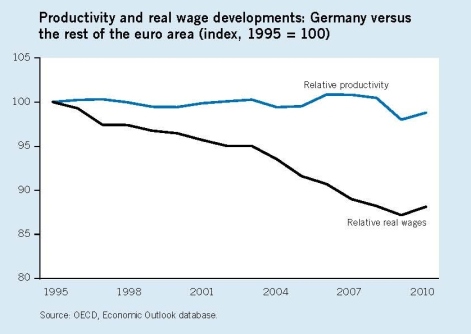 More importantly, crisis countries were barred from using the export route to make up for the shortfall in domestic demand as their manufacturing sector could not benefit from stronger aggregate demand in Germany.’ The ILO argues that ‘the current roblems are an inheritance from the ast, when ill-designed policies during the period of German reunification led to a substantial increase in unemployment which subsequently was addressed by deflationary wage policies. In the aftermath of German reunification, manufacturing industries suffered a substantial loss in competitiveness. Not only were East German companies less productive, the cash changeover rate was fixed at a rate 1:1 in comparison to an official exchange rate between the West and East German mark of around 1:4.3. As a consequence, inflation started to accelerate, in particular in the eastern part, pushing the Bundesbank to tighten monetary policy from 1991 onwards. In turn, the Deutschmark appreciated against the other European currencies leading to the demise of the European Monetary System in 1993 and a substantial loss in competitiveness with severe effects on Germany’s domestic demand as well. In fact, German firms substantially reduced their investments during the second half of the 1990s, lagging the euro area average by almost 3 percentage points annually. At the same time, job creation fell dramatically, affecting wage growth and hence disposable income of households, who reduced their private consumption. Under the impression of high and sticky unemployment, the Schröder Government initiated a series of labour market reforms starting in 2003, effectively reducing entry wages at the lower end of the labour market. Already starting in 2000, several tripartite negotiations had been undertaken in an atempt to lower wage growth and to restore price competitiveness. Partly, these reforms had been triggered by the fact that nominal exchange rates had been effectively fixed since 1995 in preparation for setting up the euro area three years later. This was also the year when the Deutschmark had reached a high point relative to currencies in main competing European countries as a result of the earlier policies enacted during reunification. Internal devaluation was, therefore, seen as the only means of restoring what was seen as a more equitable situation. However, most of the reforms essentially led to wage deflation in the services industries where new, predominantly low-wage jobs appeared. Such an approach substantially prolonged the adjustment period and until today, hourly wage costs remain among the highest in German manufacturing. At the same time, little was done to restore competitiveness through increases in productivity (see figure above). Indeed, productivity developments remained in line with other euro area countries. These wage deflation policies have not only impacted private consumption, which lagged behind that of other euro area countries by more than 1 percentage point over the period 1995 to 2001. They have also led to widening income inequalities, at a speed unseen even in the aftermath of reunification, when several million people lost their jobs in East Germany (see OECD, 2011). At the European level it has created conditions for a prolonged economic slump as other member countries increasingly see only even harsher wage deflation policies as a solution to their lack of competitiveness. This is all the more discomforting as it is unclear to what extent these wage deflation policies in Germany have contributed to higher employment levels, which in 2006 were barely higher than in 1991. As a matter of fact, recent export successes owe little to these wage policies and more to the geographical orientation of German exporters to dynamic emerging economies (see OECD, 2010). At the same time, low domestic demand has held back stronger services sector growth with adverse consequences for labour productivity in that sector and the aggregate economy as a consequence. Indeed, faster productivity growth in German services would not only allow an end to the current wage deflation policies – with positive spillover effects to the rest of Europe – it would also help restore a more equitable income distribution across wage earners.” Global Employment Trends 2012, Preventing a deeper jobs crisis, Page 46 (ILO)
France – Housing crisis
Housing has become a major theme of the Presidential election in France, from incumbent right-winger Nicolas’ Sarkozy’s proposals for a “right to buy” bonanza and new rights for homeowners to expand their homes to radical left Jean-Luc Mélenchon who is calling for a house buidling progamme of 200,000 homes a year, the requisitioning of empty homes, a stop on evictions and a cut in rents. Here’s some figures: :
- More than 130,000 homeless
- 700,000 people forced into shared accomodation
- Rental accomodation 80% dominated by private landlords
- 4.2 million households forced to live on less than Euros 500 a month once housing costs paid
- The poorest 20% represent 37% of home owners compared to 47% a few years ago; the richest 20% have increased their share of the total from 65% to 76%
- Prices have soared, substantially outstripping the general cost of living:
 Graph Key
- Prix a la consummation – inflation (CPI)
- Prix de logement anciens – prices of housing that are more than 5 years old or have been adapted more than five years ago
- Loyers moyens du parc privé – rent for privately-owned housing
- Loyer HLM – rent for social housing
Nouvel ObservateurFrance / 1.2.2012
Italy – jobless total hits 8-year high
Italy’s jobless rate rose to the highest in eight years in December as austerity measures meant to fight the debt crisis helped push the region’s third-largest economy toward a recession. Bloomberg Italy / 31.1.2012
Eurozone – Unemployment hits new record
Unemployment data for the whole eurozone shows that the jobless rate has hit its highest level since the Single Currency was created, at 10.4%. The number of jobless across the Eurozone rose by 20,000 in December. This brings the total up to 16.47 million, the eighth successive monthly rise.  The Guardian
  Eurostat Eurozone / 31.1.2012
Italy – Workplace deaths up by 5% in 2011
553 people died at work in Italy last year, an increase of 5.1% with young people the most at risk, according to the Workplace Safety Observatory (Osservatorio Sicurezza sul Lavoro) of Vega Engineering. Young people are 62% more likely to die on the job. You are most likely the suffer a lethal accident is you live in the South and least likely if you live in the North West. Agriculture (40%) is the most dangerous for your health, followed by construction (22%).
Osservatorio Sicurezza sul Lavoro
30.1.2012
Banks repossessed 6,900 Portuguese homes last year
The number of families and property developers that were forced to surrender their properties to their lenders because they no longer could afford the repayments on their mortgages, reached 6,900 last year. This figure is more than 17% up on 2010 according to a report in ‘Jornal de Negócios’ and works out at 19 properties for each day of the year.
These depressing figures were supplied by the estate agents’ trade body ‘Associação dos Profissionais e Empresas de Mediação Imobiliária de Portugal’ (APEMIP) and they reveal ‘an increasingly worrying trend,’ according to the association’s president Luis Lima Carvalho.
With banks then marketing returned properties at reduced prices to recover mortgages owed, the market becomes further depressed. Those that are trying to sell, unable to afford their mortgages, are put in a worse position as they are competing with a raft of distressed assets being sold on, often at below market value.
This vicious circle often reflects the banks’ inability to deal sensibly with their customers and work out a ‘holding pattern’ payment scheme until the market recovers, even if this is below the ‘interest only’ figure.
Many of Portugal’s banks have benefitted from the Troika bailout and have been recapitailised to the detriment of business borrowers who now find it impossible to get a loan on sensible terms. Mortgage arrears have rapidly been turned into repossessions where the bank can get some money back quickly, leaving families homeless, dependent on the state or charities for accommodation, and facing a lifetime of repayments of negative equity.
Algarve Daily News
30.1.2012
Executive pay in 2010, Italy
| Executive Pay 2010 | |||
| NAME | JOB | SALARY (million €) | |
| 1 | Alessandro Profumo | Ex ceo UniCredit | 40.590.000 |
| 2 | Luca Cordero di Montezemolo | Chairman Ferrari | 8.728.000 |
| 3 | Marco Tronchetti Provera | Chairman Pirelli | 6.618.000 |
| 4 | Cesare Geronzi | Ex Chairman Generali | 5.024.000 |
| 5 | Fausto Marchionni | Ex ad FonSaiEx ad FonSai | 5.007.000 |
| 6 | Fulvio Conti | Ad e Dg Enel | 4.941.679 |
| 7 | Giorgio Angelo Girelli | Ad Banca Generali | 4.905.768 |
| 8 | Paolo Scaroni | Ad e Dg Eni, C Generali | 4.610.000 |
| 9 | Pier Francesco Guarguaglini | Chairman e Ad Finmeccanica | 4.478.000 |
| 10 | Jacques Léost | C Saipem (fino 18/8/10)P e Dg Saipem (fino 29/8/10) | 4.447.000 |
| 11 | Pietro Franco Tali | Vp e Ad Saipem | 4.201.000 |
| 12 | Pietro Giordano | Vp Erg | 4.195.825 |
| 13 | Giampiero Pesenti | P Italcementi, C Pirelli, C Mittel | 4.000.000 |
| 14 | Roberto Vedovotto | Ad Safilo | 3.817.700 |
| 15 | Andrea Guerra | Ad Luxottica, C Parmalat, C Dea Capital | 3.800.462 |
| 16 | Fedele Confalonieri | P Mediaset | 3.718.000 |
| 17 | Sergio Balbinot | Ad e Dg Generali | 3.557.837 |
| 18 | Luca Garovaglia | P Campari, C Fiat, C Indesit(fino 29/4/10) | 3.534.105 |
| 19 | Giovanni Perissinotto | Ad e Dg Generali, Cdg IntesaSanpaolo, C Pirelli | 3.513.037 |
| 20 | Corrado Passera | Ad e Dg Intesa Sanpaolo | 3.500.000 |
| 21 | Sergio Marchionne | Ad Fiat, C Exor | 3.498.000 |
| 22 | Enrico Cavatorta | C Luxottica | 3.355.205 |
| 23 | Adolfo Bizzocchi | Dg Credem | 3.301.000 |
| 24 | Giuliano Andreani | Ad Mediaset | 3.300.000 |
| 25 | Francesco Micheli | Dg Intesa Sanpaolo (fino 9/2/10) | 3.286.000 |
| 26 | Diego della Valle | P e Ad Tod’s, C Generali, C Rcs, C Marcolin | 3.215.357 |
| 27 | Giulia Maria Ligresti | P e Ad Premafin, Vp Fondiaria-Sai, C Milano, C Pirelli | 2.985.676 |
| 28 | Maurizio Costa | Vp e Ad Mondadori, C Amplifon | 2.851.000 |
| 29 | Claudio Calabi | Ad Risanamento | 2.830.000 |
| 30 | Jonella Ligresti | P Fondiaria-Sai, Vp Premafin, C Milano, C Mediobanca, C Rcs | 2.817.205 |
| 31 | Gioacchino Paolo Ligresti | Vp Premafin, C Fondiaria-Sai, Vp Milano | 2.751.261 |
| 32 | Franco Moscetti | Ad Amplifon, C Diasorin | 2.690.000 |
| 33 | Franco Bernabè | Ad Telecom Italia | 2.598.000 |
| 34 | Massimo Moratti | Ad Saras, C Pirelli | 2.586.000 |
| 35 | Renato Pagliaro | P Mediobanca (dal 10/5/10, prima C e Dg) | 2.550.000 |
| 36 | Alberto Nagel | Ad Mediobanca | 2.550.000 |
| 37 | Francesco Trapani | Ad Bulgari | 2.538.620 |
| 38 | Gian Marco Moratti | P Saras | 2.536.000 |
| 39 | Francesco Caltagirone | P Cementir, C Acea, C Banca Finnat Euramerica | 2.532.000 |
| 40 | Giuliano Zuccoli | P Cdg A2A,P Edison, Vp Credito Valtellinese | 2.471.352 |
| 41 | Valerio Battista | Ad Prysmian, C Indesit (dal 29/4/10) | 2.451.643 |
| 42 | Gaetano Miccichè | Dg Intesa Sanpaolo (dal 9/2/10) | 2.390.000 |
| 43 | Andre Michelle Ballester | Ad Sorin | 2.265.572 |
| 44 | Francesco Gori | Dg Pirelli | 2.251.000 |
| 45 | Massimo di Carlo | C e Vdg Mediobanca | 2.250.000 |
| 46 | Maurizio Cereda | C e Vdg Mediobanca, C Ansaldo Sts | 2.235.000 |
| 47 | Jeane Claude Blanc | Ad e Dg Fc Juventus | 2.228.000 |
| 48 | Antonio Talarico | Vp Fondiaria-Sai | 2.223.372 |
| 49 | Fabio De Longhi | Vp e AdDe Longhi | 2.220.000 |
| 50 | Franzo Grande Stevens | C Exor, segretario Cda Fiat, C Rcs | 2.197.000 |
p = presidente (chair); vp = vicepresidente (vice-chair); ad = amministratore delegato (CEO); dg = direttore generale (managing director); cds = consigliere o consiglio di sorveglianza (non-executive director of supervisory board; cdg = consigliere o consiglio di gestione (director of management board) ; c = consigliere di consigliere di amministrazione Source
Debts held by Italian families rise by more than a third
In the three years to September 2011, Italian family debts have risen by 36.4%, according to Cgia di Mestre, a consultancy. Average debts are Euros 19,981. Debts with banks stand at Euros 503 billion. Italy / 28.1.2012 Cgiamestre.com
Italian poverty on increase
Poverty is on the increase among Italians and so is inequality of wealth, according to the Bank of Italy. Figures from the country’s central bank show that in 2010 14.4% of Italians were poor – defined as having an income lower than half of the average – up one percentage compared to 2008. The proportion of poor among foreign citizens residing in Italy was significantly higher, at 40%. The richest 10% of families owned 45.9% of the wealth, compared to 44.3% in 2008, showing a widening gap between haves and have nots. Bankitalia Italy /
Belgium’s precariat
15% of Belgians live under the poverty line with the expansion of precarious forms of employment a key factor, the first nationwide annual study of the issue shows. Children and elderly (65+) are the most badly affected, with poverty rates of 18.5% and 19.4% respectively The poverty line is set at Euros 973 a month for a single person and Euros 2,044 for a household of two adults and two children. Work doesn’t necessarily stave off poverty, the study found, as one in five living under the poverty line are in employment. The explanation is the growth in “precarious” jobs, says the study. In the name of increasing the country’s “competitiveness”, there has been proliferation of “flexible” work contracts in Belgium in recent years, which have been used primarily by young people and women. Just under a quarter of Belgian workers are in part-time jobs, which are also often offered as temporary contracts that are renewed repeatedly when they run out so employers can benefit from access to labour while denying workers basic employment rights. Hours worked on a temporary basis tripled between 1993 and 2006 in Belgium. Le Soir Attac Belgium Belgium / 13.1.2012
Impact of long hours
The new Spanish government’s plan to lengthen the working week in the public sector will add 12,000 to the jobless queues in Madrid alone, says the UGT trade union confederation. The job losses in the capital will be caused by the posts eliminated by increasing the working week for public sector workers from 35 hours to 37.5 hours a week. The public services federation of the UGT said that of the 12,000 jobs lost, 5,000 would be in health services as stressed staff in hospitals add to their working day. Regina Plañiol, a councillor for the Madrid administration, run by the same right-wing Popular Party that since November’s elections is now also in power at a national level, has said that public servants worked “little and badly”. Spain has Europe’s longest job queues, whose 8 point rise last year to 22.2% or over 4.4 million, has sent the economy back into recession in 2012. Europa Press Spain / 12.1.2012
Wages to fall 5% in Spain
Wages will fall 5% in real terms in Spain this year thanks a freeze in the minimum wage and price increases, according to Comisiones Obreras trade union confederation. Suggestions that wages were too high were not backed by the evidence as seven million workers earned “significantly less” than 1000 euros a month, said General Secretary Ignacio Fernández Toxo in comments reported by Europa Press. Spain / 9.1.2012
Italy youth unemployment hits new record
Portugal’s precariat
Italy services deregulation – record so far
- transport insurance has increased by 184% since 1994, against inflation of 43% meaning that prices had gone up by 4.2 times faster than the cost of living.
- banking and financial services, including the cost of having a current account and using the hole in the wall cash dispenser, went up 109%, that is, 2.5 times faster than rate of inflation.
- train fares have gone up 53% since 2000, compared to 27.1% inflation over the period, ie twice as fast.
- postal services just kept up with the rate of inflation
- electricity went up 1.8% between 2007-2011, lower than the 8.4% inflation for those years
Only medicines and telephone services have delivered savings to consumers since they were deregulated – respectively down 11% since 1995, against a 43% inflation over the period, and down 16% over the 1998-2011 period compared to 33% inflation. Cgiamestre.com Italy 4.12.2011
European executive bonuses rise across the board


Discussion
Trackbacks/Pingbacks
Pingback: Eurozone unemployment rate hits Euro era high « Revolting Europe - January 31, 2012
Pingback: On the German jobs ‘miracle’ « Revolting Europe - February 2, 2012
Pingback: If not now, when? On Italy’s thriving feminist movement « Revolting Europe - February 18, 2012
Pingback: Out of work and underpaid: the condition of women in Italy’s south « Revolting Europe - February 22, 2012
Pingback: ILO on how Germany’s low wage policy is at heart of Euro crisis « Revolting Europe - February 22, 2012
Pingback: Capital grabs more wealth than labour in Spain for first time « Revolting Europe - February 22, 2012
Pingback: Real wages fall in the Eurozone as inflation outstrips incomes. « Revolting Europe - March 15, 2012
Pingback: Portuguese workers strike against ‘social terrorism’ « Revolting Europe - March 21, 2012
Pingback: A month in Revolting Europe (May 2012) « Revolting Europe - May 31, 2012
Pingback: Gender Impact of the Austerity in Europe – In Numbers | Revolting Europe - March 8, 2013
Pingback: Filthy rich Europeans – richer than ever | Revolting Europe - March 10, 2013
Pingback: Snap Election And Market Collapse Show Greece Is Still Crippled By Crisis | EMerging Equity - December 13, 2014